Ag News
AFBF survey shows Southern farmers hit hard by rising fuel & fertilizer costs
Posted on Apr 14, 2026 at 15:43 PM
By Dr. Faith Parum, AFBF Economist
GFB News Editor Jennifer Whittaker contributed Georgia-specific information to this article.
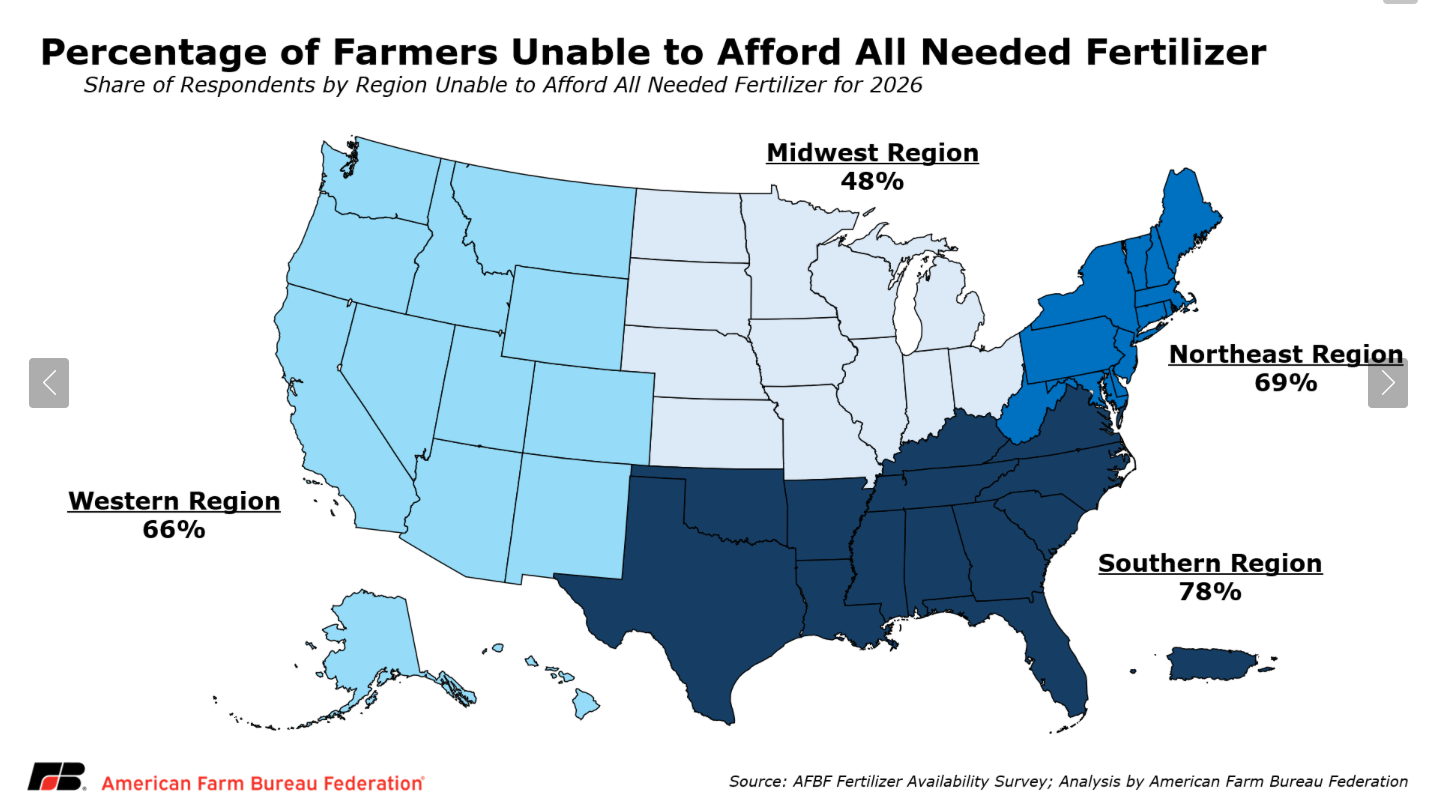
Results of a nationwide survey American Farm Bureau Federation conducted April 3-11 show high fertilizer costs are hitting Southern farmers hard, with 78% of farmers in the organization’s Southern Region (Georgia, Virginia, North & South Carolina, Kentucky, Tennessee, Alabama, Florida, Mississippi, Louisiana, Arkansas, Texas & Oklahoma) saying they can’t afford all of the fertilizer they need to grow their crops this year. Of the 121 survey responses from Georgia, 88 farmers said they can't afford all of the fertilizer they need to grow their crops this year.
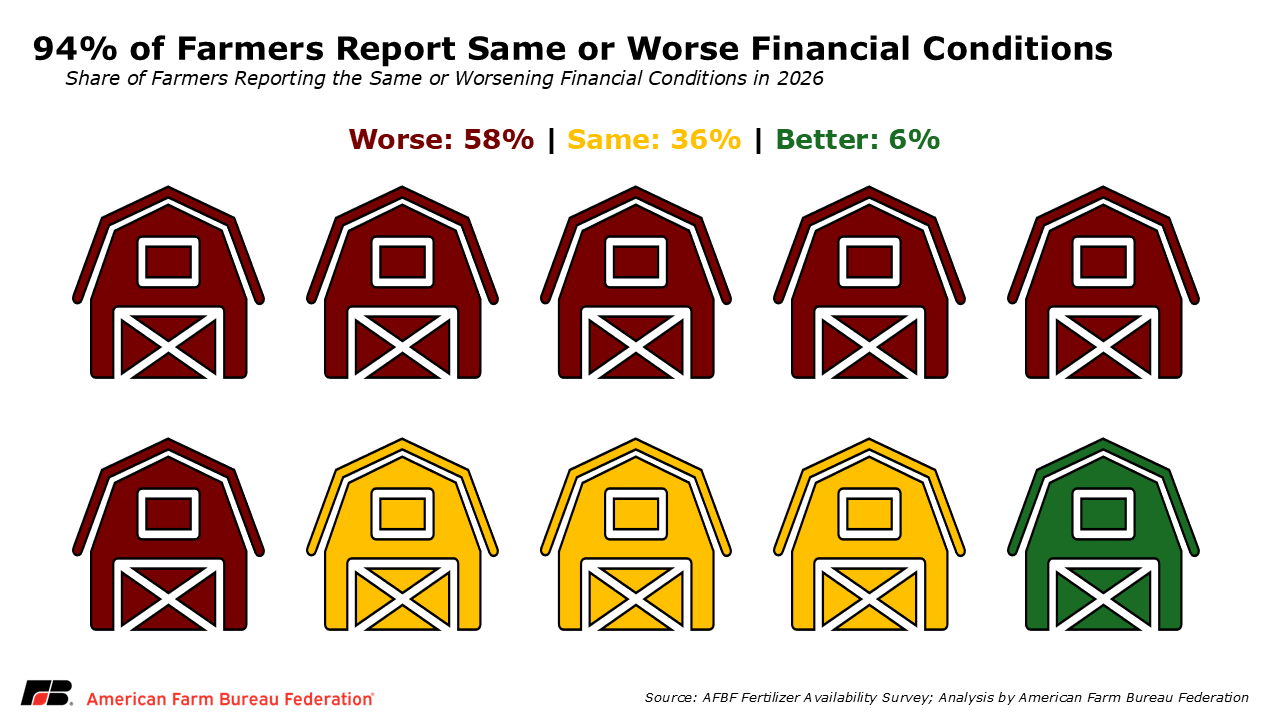
According to the survey, 94% of the 5,700 respondents from all 50 states & Puerto Rico reported their overall financial situation has worsened or remained the same since 2025: only 6% reported improvement. In Georgia, 95.5% of the respondents reported their financial situation has worsened or remained the same. Only 5% of the Georgia responses reported improvement.
Georgia had 121 responses to the survey.
Key Takeaways
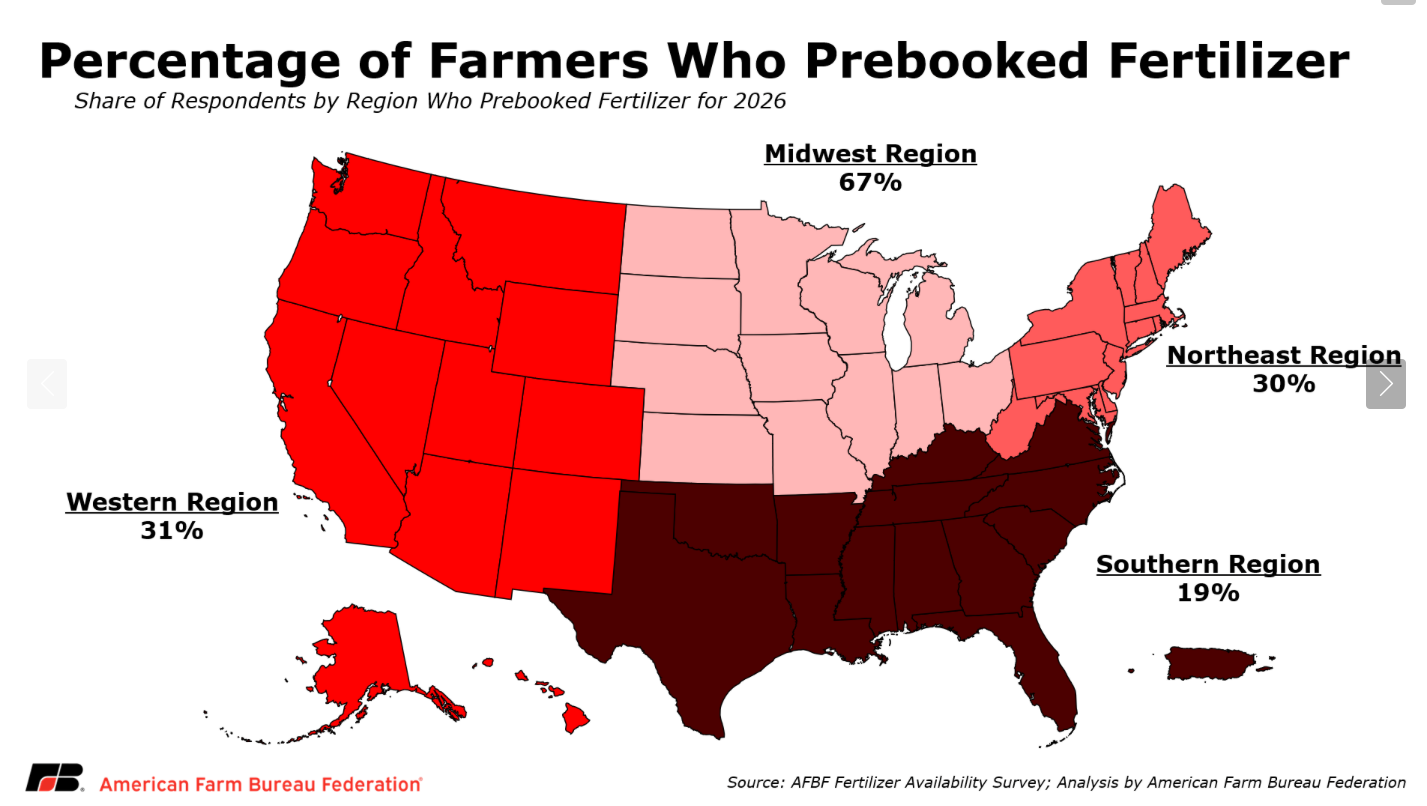
• Fertilizer pre-booking rates varied significantly by region, with just 19% of Southern producers reporting fertilizer purchases secured ahead of the season, compared to 30% in the Northeast, 31% in the West and 67% in the Midwest, reflecting differences in planting decision timelines and exposure to recent price increases. Only 9.1% of Georgia responses reported prebooking fertilizer. Reasons Georgia farmers gave for not pre-booking were: uncertainty about 2026 crop acreage plans; prices too high/waiting for prices to decrease; farmers cannot prebook without accepting delivery, and farmers don't have infrastructure to store fertilizers; and not having the cash or operating loans to prebook.
• Fertilizer affordability challenges are most acute in the South and Northeast but remain a concern for farmers across all regions. Around 70% of respondents report being unable to afford all the fertilizer they need. In Georgia, 74.4% of respondents said they will not be able to afford all the fertilizer they need.
• Farm diesel prices have increased 46% since the end of February, raising costs for fieldwork, fertilizer transport and irrigation during both planting and growing seasons. AFBF analysis shows that on average, prices for fertilizer components in the Midwest have increased as follows since the end of February: urea 47%, anhydrous ammonia 30%, liquid nitrogen 18%, potash 3% & DAP 3%.
• Nationwide, nearly six in 10 farmers report worsening finances, reflecting rising fertilizer and fuel costs during spring planting and underscoring the urgent need for immediate economic assistance to keep farms gates open. In Georgia 92 of the farmers who took the survey reported their finances being worse than last year.
AFBF economists explain that when farmers can’t afford full fertilizer application rates, they may reduce nutrient use or shift acreage decisions, both of which increase the risk of lower yields and reduced production potential in the 2026 crop year.
“Before planting season started, my family’s intention was to increase our corn acreage because corn prices were better than peanuts but since the first week of March, fertilizer prices have gone up astronomically, so we’ve had to cut our corn acreage by about 40%,” said Screven County row crop farmer Ben Boyd in upper Southeast Georgia on the South Carolina line. “Our fertilizer prices rose from 55 cents a pound to 96 cents a pound in the middle of planting corn so we’re having to shift some of our intended corn acreage to other crops like soybeans, cotton and peanuts.”
In Southwest Georgia, the Hurst-Hardy Family is facing similar tough decisions on their Thomas County farm.
“We were planning to plant 575 acres of corn at the beginning of the season but after the war started and prices went through the roof, we only planted 320 acres,” said Julie Hurst Hardy, who farms with her dad and brother. “It’s a very scary time right now. Every day we’re banging our heads against the wall trying to figure out what we can do to make it to wheat harvest to get a little bit of money to make it to our corn harvest to get a little bit of money to make it to our peanut and cotton harvest. It’s a very, very vicious cycle right now.”
In addition to cutting their corn acreage, Hardy said her family is also reducing their cotton acreage by about 690 acres cotton this year and are instead planting more soybeans.
“We’ve moved our reduced corn and cotton acres to soybeans because it’s the only thing that looks like it might be making some money,” Hurst-Hardy said. She said they are considering asking their crop consultant to advise them if there are fertilizer components they can leave off some of their crops and still break even.
Poor financial conditions going into this growing season were already affecting farmers’ planting and purchasing decisions, so, rapidly changing fertilizer and fuel prices tied to the conflict in the Middle East are adding strain to an already challenging farm economy. AFBF economists say farm diesel prices have risen 46% since the end of February, marking the largest month-to-month percentage increase in diesel prices from 2009 to 2026. Fuel is a major operating expense during spring planting as it affects what it costs farmers to run their planting equipment, irrigate in drought areas where water is needed to get the crop up and to transport farm supplies.
“Diesel prices have increased a little more than two dollars a gallon for me since the first week of March. When we started planting our crops in early March, we were paying about $2.80 a gallon for fuel and now it’s at least $5 a gallon. The higher cost of fuel touches everything we do on the farm,” Boyd said.
Fuel and fertilizer markets are the most volatile since Russia’s invasion of Ukraine, AFBF economists say and the duration of disruptions in the Middle East and closure of the Strait of Hormuz will ultimately determine farm production expenses in the months ahead – a variable that significantly impacts farm margins given historically low crop prices. While the United States is the world’s largest producer of oil and natural gas, fuel and fertilizer markets remain globally interconnected.
Fertilizer cost impact reflects differences in regional crop mix, production practices & farm size
Rising fertilizer costs are affecting U.S. farmers differently depending on where they live due to regional differences in crops grown, production practices and farm size.
For example, only 19% of Southern farmers responding to the AFBF survey reported pre-booking fertilizer for the 2026 crop year at lower prices than current market prices. That can be attributed to several factors according to Georgia farmers GFB media spoke with: Southern farms didn’t have the cash nor equity at the end of 2025 to pre-book fertilizer; Southern farms don’t have facilities to store pre-booked fertilizer supplies until needed; Southern farms grow a wider variety of crops than Midwestern farms, and many Southern farms have sandy soils, which tend to leach fertilizer when it rains, so farmers typically only buy and apply fertilizer for their crops as needed.
“Southern producers often grow crops such as cotton, rice, soybeans, corn and peanuts that rely heavily on applied nutrients and can be particularly sensitive to changes in fertilizer costs. Pre-booking rates are similarly limited in other regions, with just 30% of farmers in the Northeast and 31% in the West securing fertilizer ahead of the season,” the AFBF Market Intel summarizing the survey reports.
Midwestern producers, who mostly grow corn and soybeans, reported higher pre-booking rates of fertilizer, with 67% securing fertilizer earlier in the season. Given these crop rotations, pre-booking is more common in the Midwest, where fertilizer needs are typically larger and purchasing decisions are often made well ahead of planting. As a result, a larger share of Midwestern farmers reported being able to secure the inputs they need before recent price increases. Even with higher pre-booking rates, nearly one in three Midwestern farmers still report entering the season without securing all of their fertilizer needs.
The AFBF survey also found that smaller farms reported substantially lower fertilizer pre-booking rates than larger operations across every region, suggesting greater exposure to recent price volatility during the spring purchasing window. In the South only 16% of farms with 1–499 acres pre-booked fertilizer, 20% of farms with 500 to 2,499 acres and 28% of farms with 2,500+ acres. In the Northeast, only 24% of the smallest farms pre-booked fertilizer, compared to 35% of mid-sized farms and 67% of the largest operations. Similar patterns appeared in the West (25% of smallest farms, 33% of midsize farms and 54% of larger farms. In the Midwest, 49% of small farms pre-booked fertilizer, compared to 77% of midsize farms and 76% of large farms.
AFBF economists say because smaller farms are less likely to secure fertilizer ahead of the season, they are more exposed to in-season price increases, which can make it harder to afford full application rates and increase the risk of reduced yields and tighter margins in 2026.
Fertilizer Impact by Commodity
The AFBF survey also shows that pre-booking behavior of farmers varies significantly across commodities. Nearly half of soybean producers reported pre-booking fertilizer (49%), followed by barley (47%), corn (44%), and wheat (42%) growers. Lower pre-booking rates among cotton (13%) and peanuts (9%), both crops grown in the southern U.S., suggest greater farm exposure to in-season price volatility.
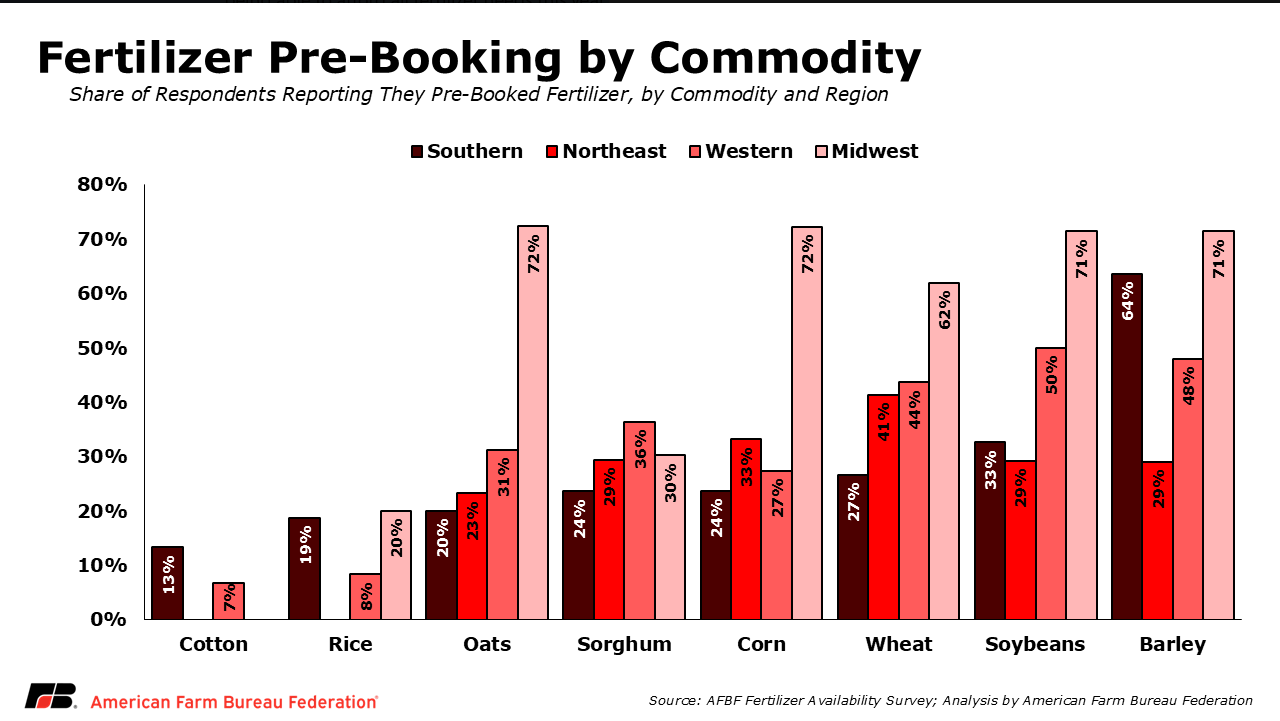
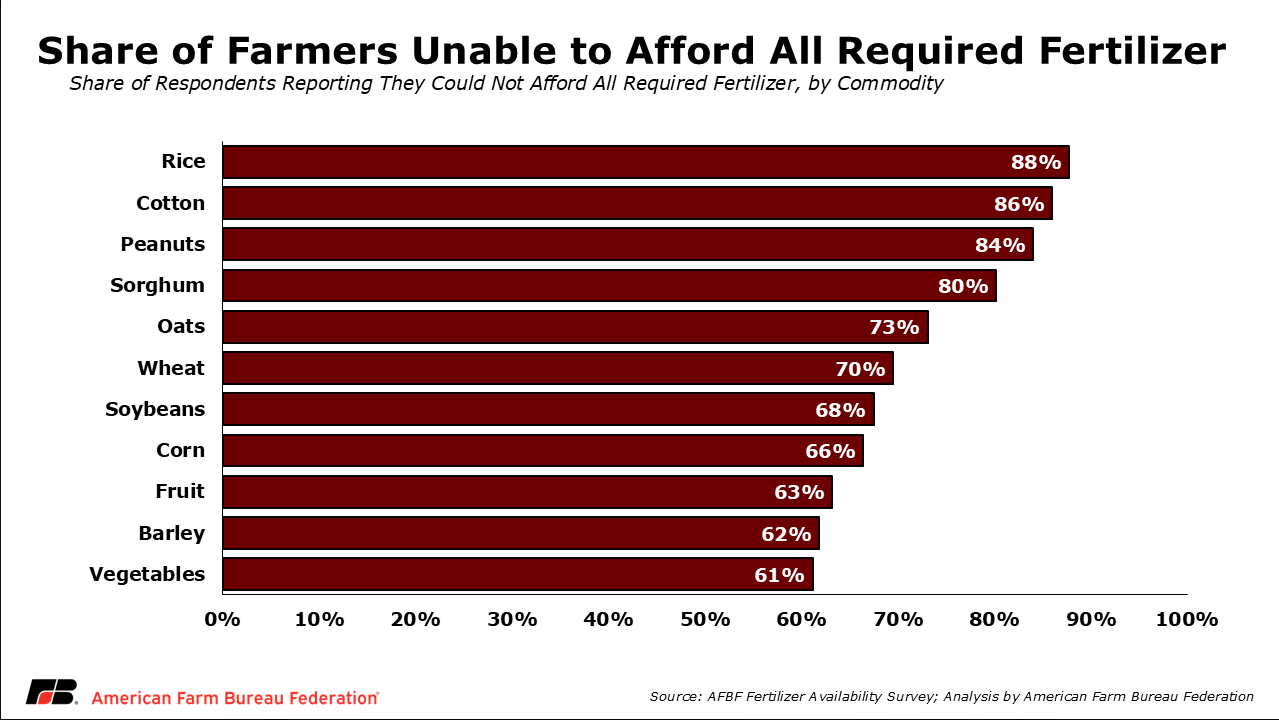
Affordability concerns are more pronounced when viewed by commodity. More than 80% of rice, cotton and peanut producers reported they cannot afford all required fertilizer, highlighting the vulnerability of these production systems to input cost shocks. Over half of all commodities report not being able to afford all fertilizer needs this year.
Bottom Line
Fuel and fertilizer markets are the most volatile since Russia’s invasion of Ukraine in 2022, and the duration of disruptions in the Middle East and closure of the Strait of Hormuz will ultimately determine farm production expenses in the months ahead – a variable that significantly impacts farm margins given historically low crop prices, AFBF economists say. While the United States is the world’s largest producer of oil and natural gas, fuel and fertilizer markets remain globally interconnected.
Countries exposed to instability in and around the Persian Gulf account for roughly 49% of global urea exports and about 30% of global ammonia exports. Because these products are essential for crop production, disruptions in the region can influence fertilizer availability and prices well beyond the Middle East.
Survey results suggest many farmers are already adjusting fertilizer purchases and application decisions in response to rising costs. If disruptions persist, these adjustments could affect yields, acreage decisions and overall production potential in the 2026 crop year. The first opportunity to see how farmers reacted will come with USDA’s May World Agricultural Supply and Demand Estimates (WASDE) report, followed by the June 30 Acreage report.
Domestic Food Production Security is National Security
in March, American Farm Bureau Federation (AFBF) President Zippy Duvall sent a letter to President Donald J. Trump and testified before the Senate Agriculture Committee seeking help from the federal government to ease farmers’ financial challenges, particularly those related to fertilizer and fuel costs. AFBF recommended a number of actions the federal government could take to mitigate fertilizer supply and price challenges, including using the U.S. Navy to facilitate safe passage through Hormuz, leveraging federal tools to address insurance or financing barriers to maritime transport, taking steps to improved domestic transportation and suspending tariffs on imported fertilizer products.
While testifying before the Senate committee, Duvall suggested a variety of solutions for increasing demand for U.S.-grown agricultural, saying "We must reinforce our production capacity of critical ag supplies and restore domestic processing capacity."
Solutions Duvall offered include authorizing year-round E15, modernizing farm labor programs and establishing improved programs to enable schools and our military to purchase directly from local farms.
The Trump administration has announced plans to help ensure the safe passage of fuel shipments through key global shipping lanes. Expanding these protections to include agricultural input supplies such as fertilizer should also be a priority given their importance to food production and national security.
Given the worsening financial conditions on the farm, support is building for additional economic aid for farmers in any upcoming legislation to help offset economic hardships made more challenging by recent increases in fertilizer and fuel prices.
On March 18, President Trump issued an executive order suspending the Jones Act for 60 days. The Jones Act, officially called the Merchant Marine Act of 1920, requires transport of goods between U.S. ports to be done on U.S.-built vessels sailing under the U.S. flag.
- Categories:
- Tags: