Ag News
GDA working to disperse HH block grant funds by end of fall
Posted on Aug 19, 2026 at 14:30 PM
Georgia Farm Bureau (GFB) held its 2026 Commodity Conference at the UGA Tifton Campus Conference Center Aug. 13. Speakers gave members of the organization’s 20 commodity advisory committees updates on a variety of agricultural issues.
GFB kicked off its annual policy development process during afternoon meetings as the committees reviewed the organization’s state and federal policy pertaining to their specific commodities.
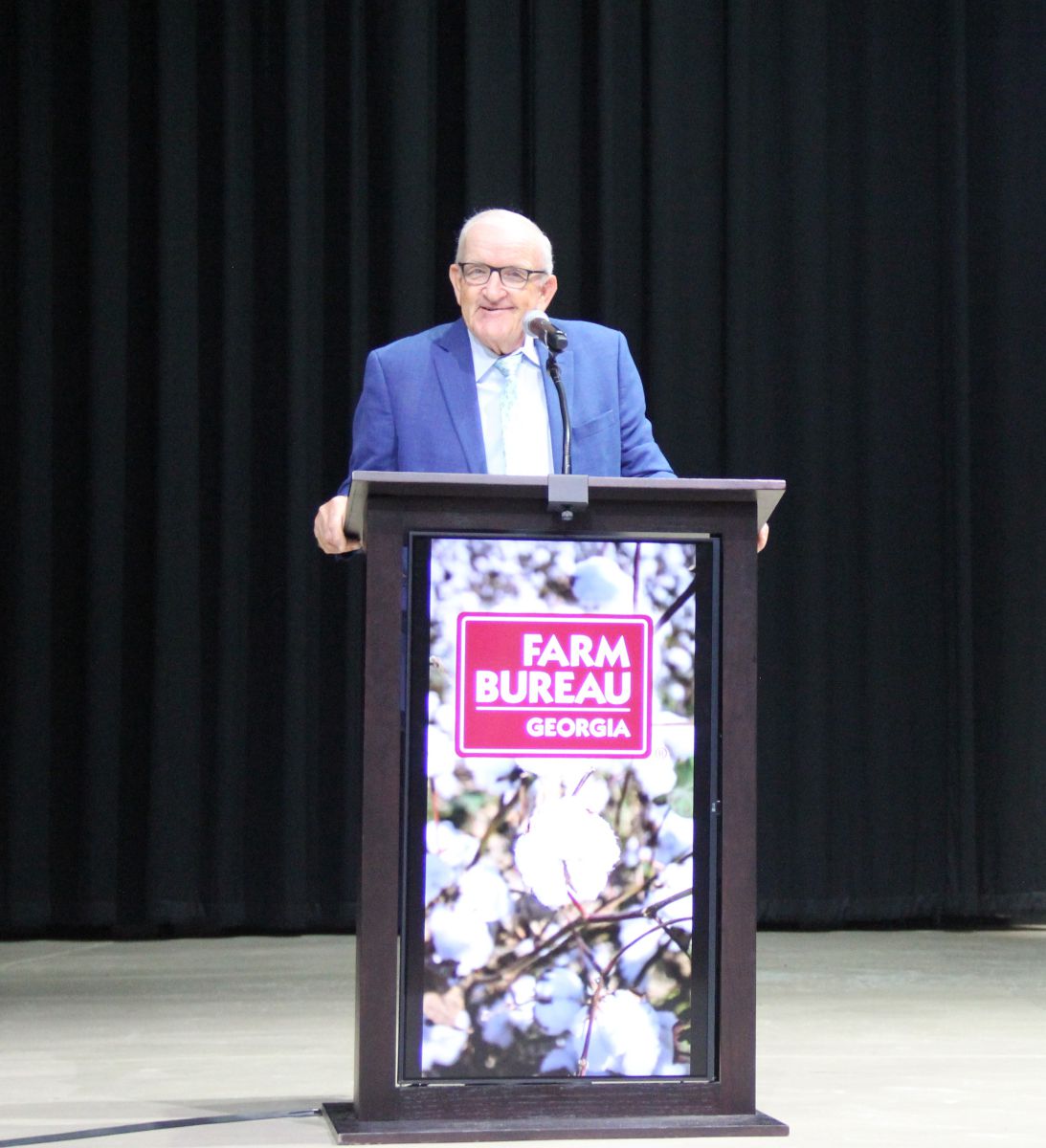
“This is Georgia Farm Bureau’s 47th Annual Commodity Conference. We’ve been holding this meeting for well over half of Georgia Farm Bureau’s 89 years,” said GFB President Tom McCall, pictured above. “The purpose of Georgia Farm Bureau since 1937 has been to represent farmers in the legislative arena. The discussions you have in your commodity meetings this afternoon start Farm Bureau’s policy development process, which determines how we represent you in Atlanta and D.C. You can propose new policy concerning your commodities, suggest alterations to existing policy or propose we delete current policy. The policy you propose is usually picked up by the state policy development committee without change.” /Photo by Jennifer Whittaker
Harper gives update on Hurricane Helene block grants
While speaking during the general session of the conference, Georgia Commissioner of Agriculture Tyler Harper gave a status update on the USDA Hurricane Helene Block Grants, saying staff from the Georgia Department of Agriculture (GDA) and Georgia Forestry Commission (GFC) have been working diligently to review the almost 5,900 applications that were received by the May 11 deadline. The USDA awarded Georgia $531.236 million to be dispersed to farmers, ranchers and timber producers who did not receive compensation for losses due to Hurricane Helene through pre-existing USDA programs. Visit https://gfb.ag/hhblockgrants to read more about the program.
After initial reviews of all the applications, Harper said a little more than 4,200 applications were deemed eligible for full review. About 1,700 applications were disqualified because they were incomplete (more than 1,300), found to be fraudulent, or were duplicate applications. Harper said a little over 3,200 of the total applications were for timber losses; about 1,400 applications were for agriculture related losses; and about 630 of the total applications reported both ag and timber losses.
.JPG)
“Based on what our review team has been working through at this time, applicants have requested a little over $900 million in potential payout. We’ve only received a little over $531 million,” said Commissioner Harper, pictured above. “The way we’re working to do this is basically through proration. Once all of the reviews are completed and the final total of the approved eligible requests are known, every payment will be adjusted by the same factor, so every eligible applicant receives the same proportional share of what they were approved for based on the available funding. The final requested total will continue to shift as reviews are done, which is part of why final payments can’t be determined until the review process is completed. I want to note that we [GDA] asked the USDA for over $1 billion in block grants. Unfortunately, there was only enough funds to cover us for a little over $531 million.” / Photo by Jennifer Whittaker
“Final payments can’t be determined until all of the applications have been reviewed,” Harper said. “We anticipate distributing payments by the end of this fall.”
The team reviewing the block grant applications consists of about 35 members, Harper said, who are either GDA or GFC employees or contractors. All team members have agriculture, forestry and disaster assistance review backgrounds.
“We remain committed to a process that's thorough, fair, and accountable, and one that gets help to producers who earned it, while at the same time protecting the integrity of this historic recovery effort. It is a difficult task, but one that our team is committed to,” Harper said. “We’re keeping our administrative cost as low as possible, and at the same time, the Georgia Department of Agriculture is absorbing significant costs to cover the administration of this program. Could we do this faster? Yes, but that means less money going back to people that deserve the funds. Since we started this process, our goal has been to cover as many producers and commodities as possible while ensuring no funding goes back to Washington D.C.”
Harper said that GDA and GFC law enforcement staff are looking into any legal or criminal action that may be taken against individuals who filed fraudulent applications.
“We have had to devote real resources of our staff’s time identifying fraudulent applications. They look real, they look complete, they look right, but when we dig into it, we find out that it is fraudulent, or it is completely inaccurate and done in a way to defraud the system. It’s a shame that anyone would take advantage of a program built to help producers recover from one of the worst storms in our state’s history. But every suspected case so far is being investigated. We are taking this very seriously.”
According to the GDA website, block grant applicants will be notified if they meet all eligibility requirements and asked to sign an agreement with an award amount. Payment amounts will not be finalized until all applications reach final review. The schedule for distributing payments to eligible producers will be announced at a later date. Visit www.gfb.ag/hhblockgrantsreview for the latest information.
Georgia Farmland Conservation Fund Update
The Georgia Farmland Conservation Fund (GFCF), created by the Georgia General Assembly in 2023 to protect farmland from development, has extended its first offers to Georgia landowners totaling almost $5 million, Harper said.
“We received 25 applications from Georgia landowners that totaled about $13.5 million dollars in requests. We have about $1.9 million from the General Assembly that we can disperse, and this money is matched with federal money, so in essence, our $1.9 turns into almost $5 million,” Harper said. “We’re really proud of the work we’re doing to protect ag land across our state. I appreciate Farm Bureau’s work on this with us together.”
GFB advocated for the farmland conservation fund. GFB President Tom McCall is vice chairman of the GFCF Advisory Council, and GFB 2nd District Director Russ Moon serves on the council.
Landowners who received GFCF offers are now considering if they will accept them. A final announcement of recipients is expected later this year once offers have been accepted and finalized. Offers are being made to preserve just under 1,000 acres in six counties, according to the GDA.
Visit https://gfb.ag/gaconservationfund to read more about the GFCF.
- Categories:
- Tags: