Ag News
Georgia Farm Bureau members meet for 88th Annual Convention
Posted on Dec 17, 2025 at 12:41 PM
Some 1,370 Georgia farmers and agribusiness leaders from across the state met on Jekyll Island Dec. 7-9 for the 88th Annual Georgia Farm Bureau (GFB) Convention. The three-day event included a trade show, awards presentations and educational sessions that briefed farmers on policy and production issues affecting Georgia’s major commodities.
The convention’s theme, “Rise and Thrive,” emphasized how the organization and Georgia’s agricultural community has worked together to help Georgia farmers hit by Hurricane Helene, last year, recover from the storm.
GFB President Tom McCall delivered his annual address, and GFB Chief Administrative Officer Jeffrey Harvey gave an organizational update.
Georgia Commissioner of Agriculture Tyler Harper, Georgia House Speaker Jon Burns and U.S. Navy Retired Commander Frank “Walleye” Weisser addressed convention delegates during the general session on Dec. 8.
McCall discusses GFB leadership programs & legislative efforts
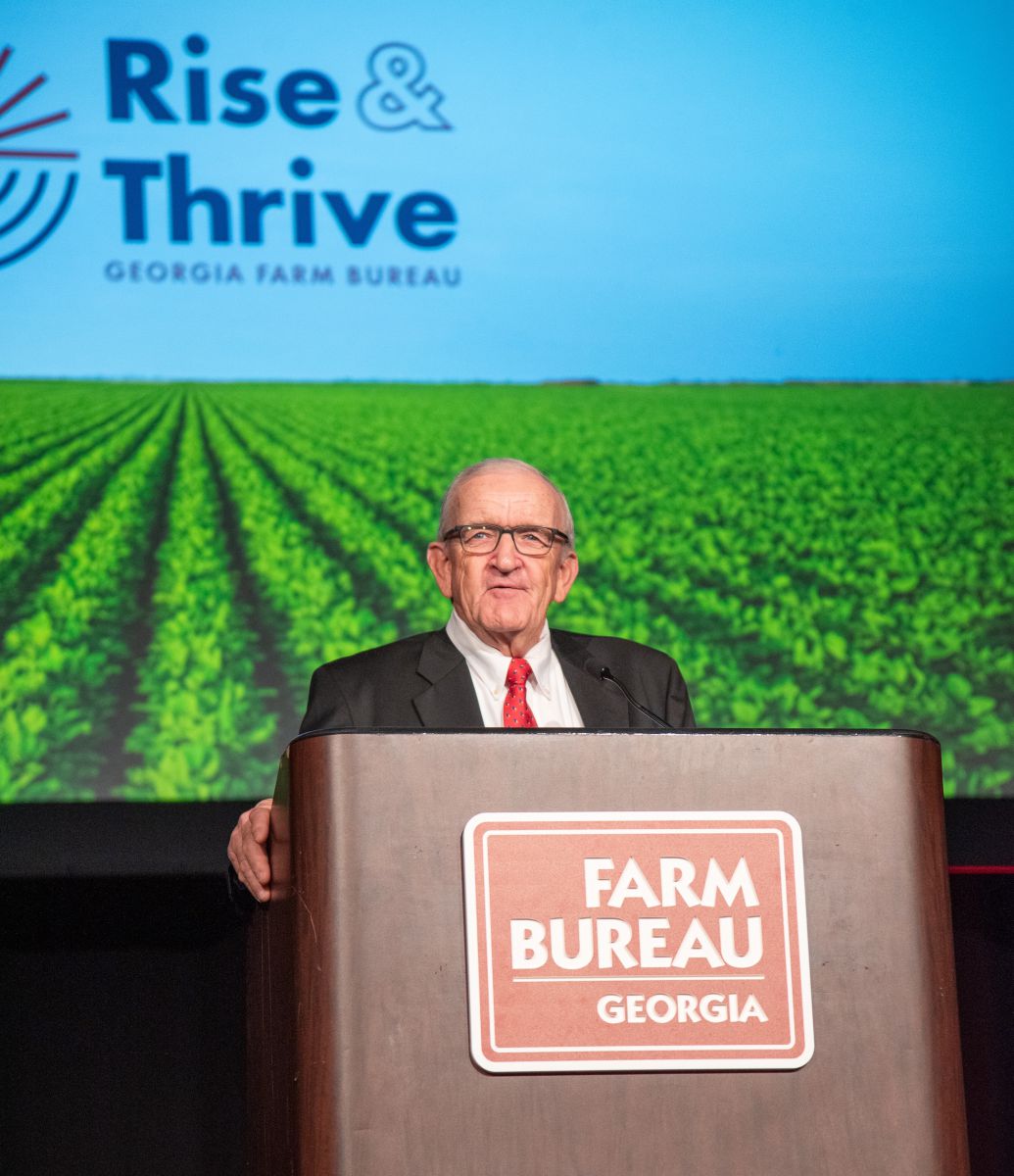
Tom McCall reiterated the organization’s commitment to helping Georgia farmers recover from Hurricane Helene, outlined how GFB is developing future agricultural leaders and discussed the legislative issues GFB advocated for on behalf of farmers this year. / Photo by Logan Thomas
“We are not defined by the number of times we fall, but rather by how many times we rise and how we thrive afterwards. This message hits home after what we all went through with Hurricane Helene, which devastated farms, families and entire communities,” McCall said. “Helene also revealed something powerful: the faith, endurance and unity of Georgia farmers. Our faith, determination and unity define us. That’s what Georgia Farm Bureau stands for – protecting your right to farm and protecting your family from loss.”
On Oct. 1, GFB announced the launch of a new program, Leadership GFB, which will equip rising and current GFB leaders with the tools they need to successfully advocate for agriculture, develop leadership skills, and embody the organization’s grassroots mission. Participants will attend sessions focused on leadership development, understanding the county, state and national structure of Farm Bureau and its grassroots network, policy work on agricultural issues, and the importance of agricultural literacy. GFB is expected to announce the class by Dec. 22.
McCall outlined how GFB is also laying the foundation for its next generation of leaders through chapters of Collegiate Young Farmers & Ranchers at ABAC and UGA. Officers from both chapters are being given opportunities to experience Farm Bureau from the inside out.
GFB also offers leadership programs through its Young Farmers & Ranchers Program for farmer members ages 18-35 and for female agriculturalists of all ages through its Women’s Leadership Program.
McCall stressed that GFB’s primary focus will always be to serve as the voice of farmers in the legislative arena.
In 2025 GFB supported tort-reform legislation, secured protection from unfair pesticide liability, secured practical truck-weight limits, fought for a common-sense federal definition of navigable waters, and for state deer-management improvements.
“We also pushed hard on the farm bill and disaster relief funding for Hurricane Helene victims. Every year bad pieces of legislation surface that could hurt your farms and families. GFB’s advocacy team helps stop them all while advancing the good bills to the governor’s desk.”
Savannah Port vital to U.S. ag exports
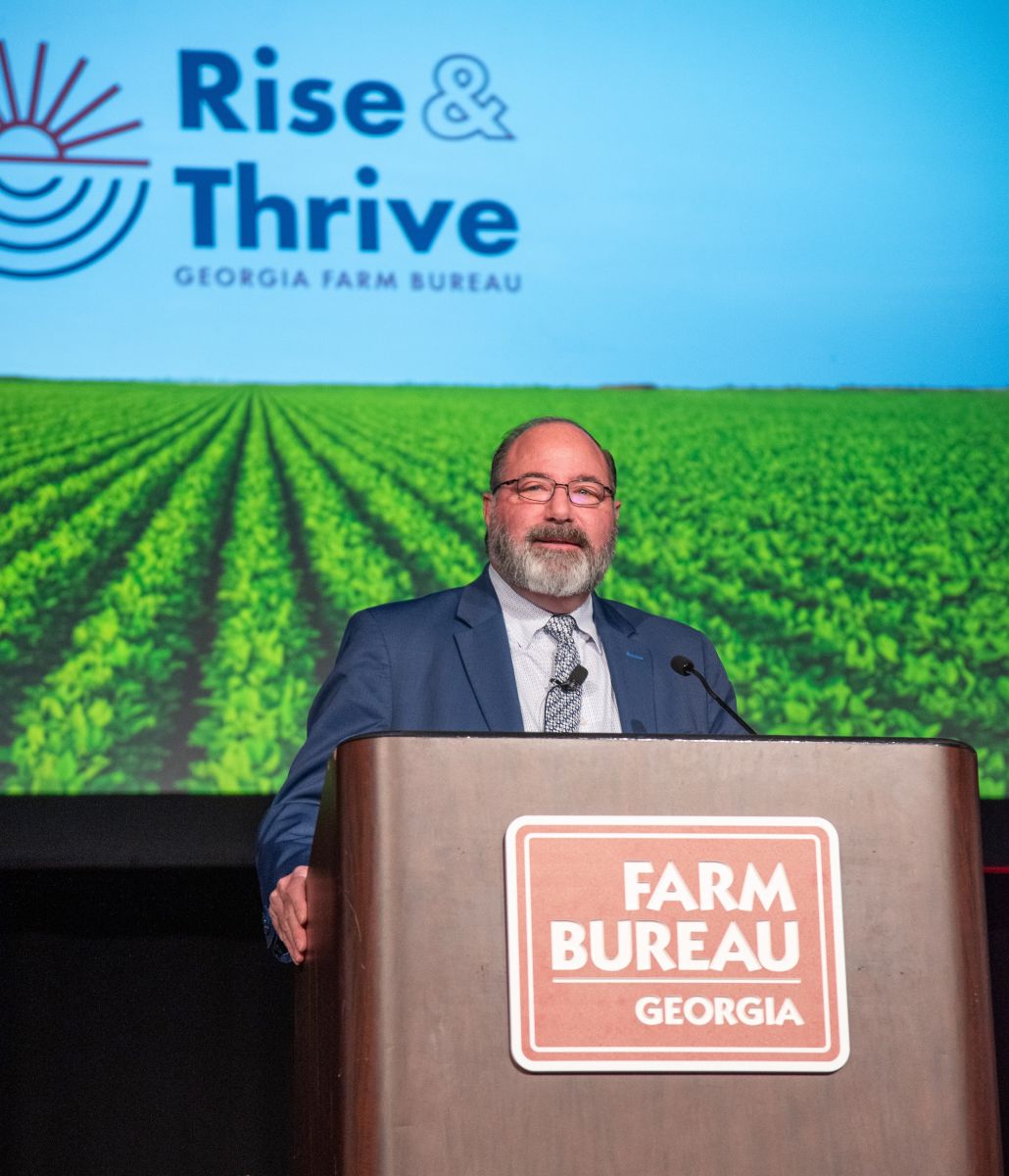
Georgia Ports Authority Chairman Kent Fountain gave an informative overview of the Savannah/Garden City port while addressing GFB convention attendees during the Dec. 8 general session of the GFB convention. / Photo by Logan Thomas
“We want to be the easiest port to do business with,” Fountain said. “We want to help you move your product throughout the world. Our mission is to be the economic engine for agriculture.”
Fountain said the Savannah port is second in the U.S. for ag exports behind the Los Angeles port. In the past year, 13% of all U.S. ag exports were shipped via the Savannah port while the Los Angeles port shipped 16% of U.S. ag exports. He said about 45% of Savannah’s exports are agricultural products. Raw cotton accounts for 15% of Savannah’s ag exports, and the port handles 37% of cotton exported from the U.S. The amount other commodities contribute to all ag exports shipped out of Savannah are: poultry 9%, pet and animal feed 7%, logs and lumber 6%, field seeds & bulbs 4%, grain & flour products 1%, meat 1%, and other ag products 3%.
Fountain said 70% of the United States’ population is served by products that move through the Georgia Ports Authority. The Savannah/Garden City port is the 43rd most connected port in the world and is the second most connected port in the U.S.
“On average, we can get products from the ship onto the rail within 24 hours to be moved to their next destination. We’re very proud of this,” Fountain said.
The port is the only one in the U.S. that has a customs facility onsite, he said.
Harper discusses USDA Hurricane Helene block grants & Farmer Bridge Assistance
While speaking at the convention, Georgia Agricultural Commissioner Tyler Harper said Georgia Department of Agriculture employees have spent hundreds of hours crafting a block grant plan to disperse the $531 million the USDA announced in September it has allocated to the state to help farmers who suffered loss to Hurricane Helene on Sept. 27, 2024. Georgia’s block grant program will cover losses caused by Hurricane Helene in 89 eligible counties for timber, poultry, beef cattle, dairy cattle, milk loss, dairy feed loss, pecans, blueberries, citrus, nursery, plasticulture, ag infrastructure, and bare ground practices due to Hurricane Helene.
.jpg)
Georgia Commissioner of Agriculture Tyler Harper. / Photo by Logan Thomas
“USDA has our final agreement and plan in their hands, and we expect to make an announcement on the details of the program and how to apply any day now,” Harper said.
Visit www.farmrecovery.com for program details, such as a list of eligible counties and the types of documents applicants will need to submit with their application. Eligible timber producers and farmers should periodically check the website in the days to come to download an application.
As the general session ended, Harper returned to the podium to say he had just been notified that USDA was announcing the rollout of a $12 billion relief package designed to help farmers nationwide manage rising production costs and ongoing market disruptions. Most of the funds - up to $11 billion - will flow through the new Farmer Bridge Assistance Program, aimed at row crop producers including corn, cotton, peanuts, soybeans, wheat, oats, sorghum, canola, and other row crops.
Another $1 billion will be directed toward specialty crops and other commodities, with additional program details expected in the coming weeks.
According to USDA, payments are scheduled to begin rolling out by Feb. 28, 2026. Producers must ensure their 2025 acreage reports are filed with their local USDA Farm Service Agency by 5 p.m. ET on Dec. 19, 2025, to remain eligible.
Visit https://gfb.ag/USDAfarmbridgeassistprogram to read more about the assistance package.
Burns: Chopping away at timber issues
Georgia House Speaker Jon Burns reviewed steps the state legislature took during its 2025 session to aid farmers in the recovery from Hurricane Helene that includes reforestation tax credits and harvest tax suspension for 2025 related to Helene damage. Timber owners must apply by Dec. 31, 2025, to receive the exemptions. Visit https://gfagrow.org/helene-resources/ for more information and to download the applications.
.jpg)
Georgia Speaker of the House Rep. Jon Burns. / Photo by Logan Thomas
Burns also discussed avenues the state is pursuing to help Georgia’s timber sector and forestry stakeholders through long-term solutions with new-product-development at research institutions regarding sustainable aviation fuel and modern timber-based building materials.
“These opportunities represent long-term solutions. You can’t do them overnight,” Burns said. “I can assure you that I and my colleagues in the House have been working for the last few months on solutions that … I believe will have an immediate impact and provide urgent relief to timber growers, timber owners and forestland owners in the state.
Burns noted collaborations with state house speakers in Arkansas, Mississippi, South Carolina and other states, congressional delegations from Georgia and other southern states, federal agencies and the Trump administration. He mentioned conversations with Small Business Administrator (SBA) Kelly Loeffler to let her know that recent timber mill closures affect businesses of all sizes.
“There’s a ripple effect,” Burns said. “It’s across all of our communities. We want to inform them that we need some help.”
As a result, Burns said, SBA is helping in the development of strategies to adjust policies and regulations to provide relief.
The engagement has included work with United States Trade Representative Jameson Greer to make small changes to trade policy to remove what Burns called arbitrary trade barriers.
One such barrier is the export to the European Union of forest products fumigated with sulfuric fluoride. Burns said the product is licensed and widely used in the U.S. and the EU.
Another is tariffs relating to the transship clause, which Burns would like to see clarified to exempt wood that was grown in the U.S., shipped to other countries as manufacturing material, then returned to the U.S. as finished products.
“We’re asking for a slight clarification that will reassure importers when the products are imported back into this country that those products can be tariff-free and tariff-exempt, if they can
provide documentation that the raw products that were utilized to prepare and manufacture those products originated here in this country,” Burns said.
Burns noted that the federal government is being asked to establish a 90-day notice before a changed tariff goes into effect.
“These are nothing but slight adjustments to existing language and policy that will provide the forest industry with a little breathing room,” Burns said.
Weisser: Failure is necessary for growth
.jpg)
Keynote speaker Frank “Walleye” Weisser shared his experiences as a Navy pilot, including two stints as a member of the Blue Angels and as pilot for Tom Cruise’s aerial scenes in the movie Top Gun: Maverick. / Photo by Logan Thomas
Weisser discussed the detail and focus required to do what Navy pilots do, driving home how difficult it is. He attended the U.S. Naval Academy and originally wanted to be a Navy SEAL. But, when Weisser got to service selection – when the Navy informs cadets what form their service will take – he was assigned to be a Navy pilot.
“To say I felt like a failure would be an unbelievable understatement for me,” Weisser said. “I called all my friends, and I said, ‘Everything you watched me strive for, I failed out.’ ”
Once enrolled in flight school, there is no transition to become a SEAL.
“The lesson I learned at that point was that up until that time, I was being selfish. It’s not selfish to serve your country. It’s not how I serve. It’s just that I serve.”
Flight school offered no smooth sailing. He failed his first test. When he got into a plane, he never got it off the ground. Once he got off the ground, more mistakes followed.
“I kind of failed into aviation and accelerated the failures from there. But at some point, it turned around,” Weisser said. “I share this with you, especially for individuals in this room who are young and have been successful at everything you’ve done, because at some point if you push yourself, you will fail.”
Failure, he said, isn’t final.
“You have to have the willingness and the desire to keep going. For me, these failures became unquestionably the biggest blessing in my life,” he said.
After Blue Angels shows, the pilots and flight crews go through debrief that includes a dose of self-review of all the mistakes each person made.
Admitting mistakes, he said, allows teams to move forward and builds trust.
“If you sit in front of people who work for you, who are junior to you, who are less experienced, and you’re willing to say, ‘I screwed this up,’ that’s really, really powerful.”
Harvey: GFB Convention matters and greatest value is relationships
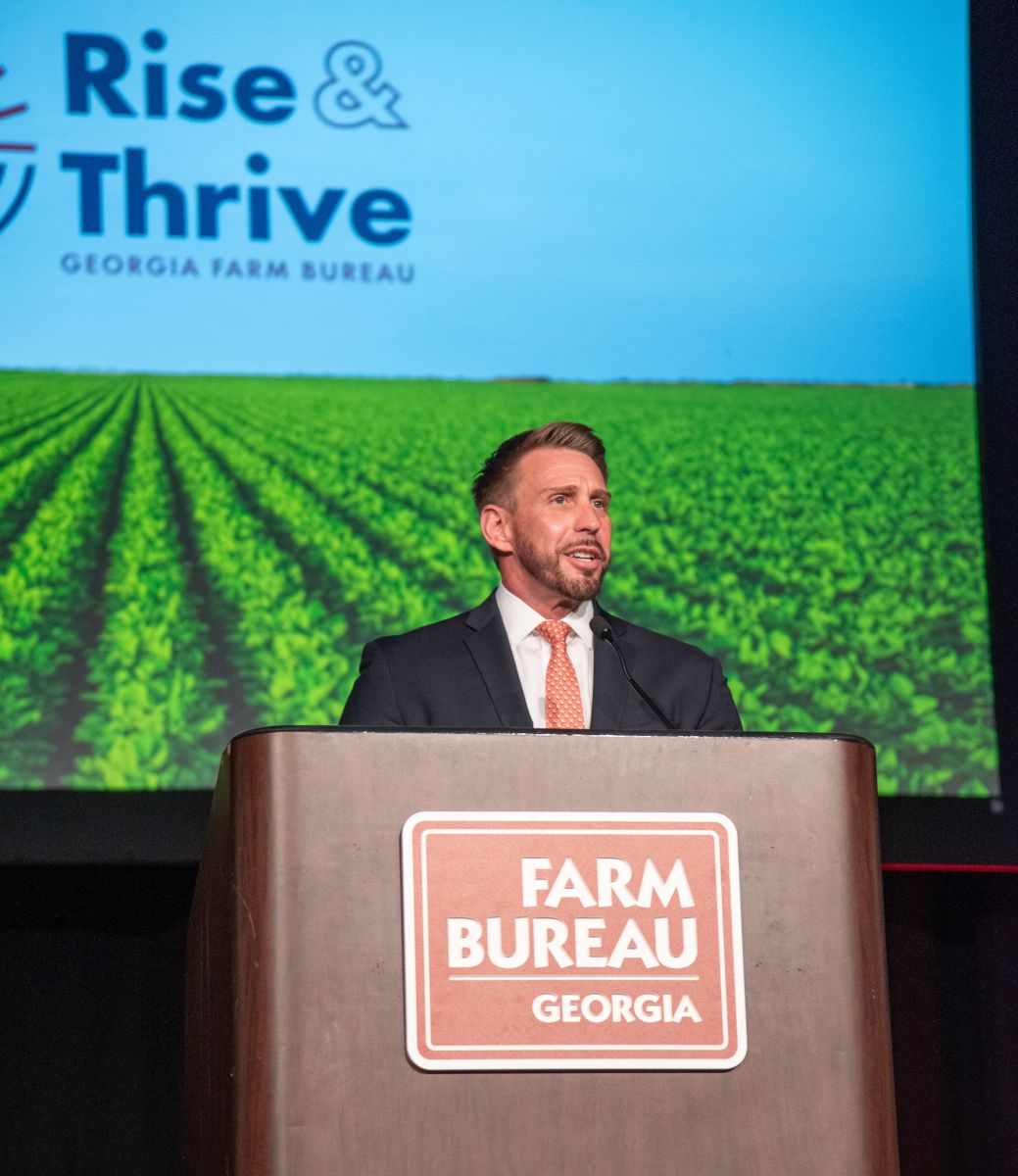
Georgia Farm Bureau Chief Administrative Officer Jeffrey Harvey welcomed attendees to the convention and said its importance lies in fostering personal connections that help the organization build on its successes. / Photo by Logan Thomas
“This convention matters and your presence here matters,” Harvey said. “We want you to leave here with more than you came with. If you look at national statistics on what draws people to organizations like ours, more than 70% say the greatest value they receive is the relationships.”
This entails being around people who understand the challenges you’re facing and having opportunities to share ideas and trade stories with people who live it and breathe it, he said.
“There’s no better place to do that than right here at your annual convention,” Harvey said. “This is your chance to learn, to network, to strengthen those friendships that have made this organization great and will continue to make the organization great moving forward.
Harvey compared the GFB Convention on Jekyll Island to the meeting of financial leaders on the island in 1910, during which the forerunner of the Federal Reserve System was created.
“That meeting shaped the entire American financial system that we know today, and the decisions made at that meeting affect every farmer in this room,” Harvey said. Similarly, GFB’s convention generates ideas and policies that can affect farmers statewide. “That’s why this meeting matters.”
- Categories:
- Tags: