Ag News
Georgians urged to report Yellow-Legged Hornet nests, embryos
Posted on Jun 24, 2026 at 14:15 PM
The Georgia Department of Agriculture is urging residents—particularly those in Bryan, Bulloch, Chatham, Effingham, and Liberty counties—to remain vigilant and report sightings of Yellow-Legged Hornet (YLH) secondary and primary nests.
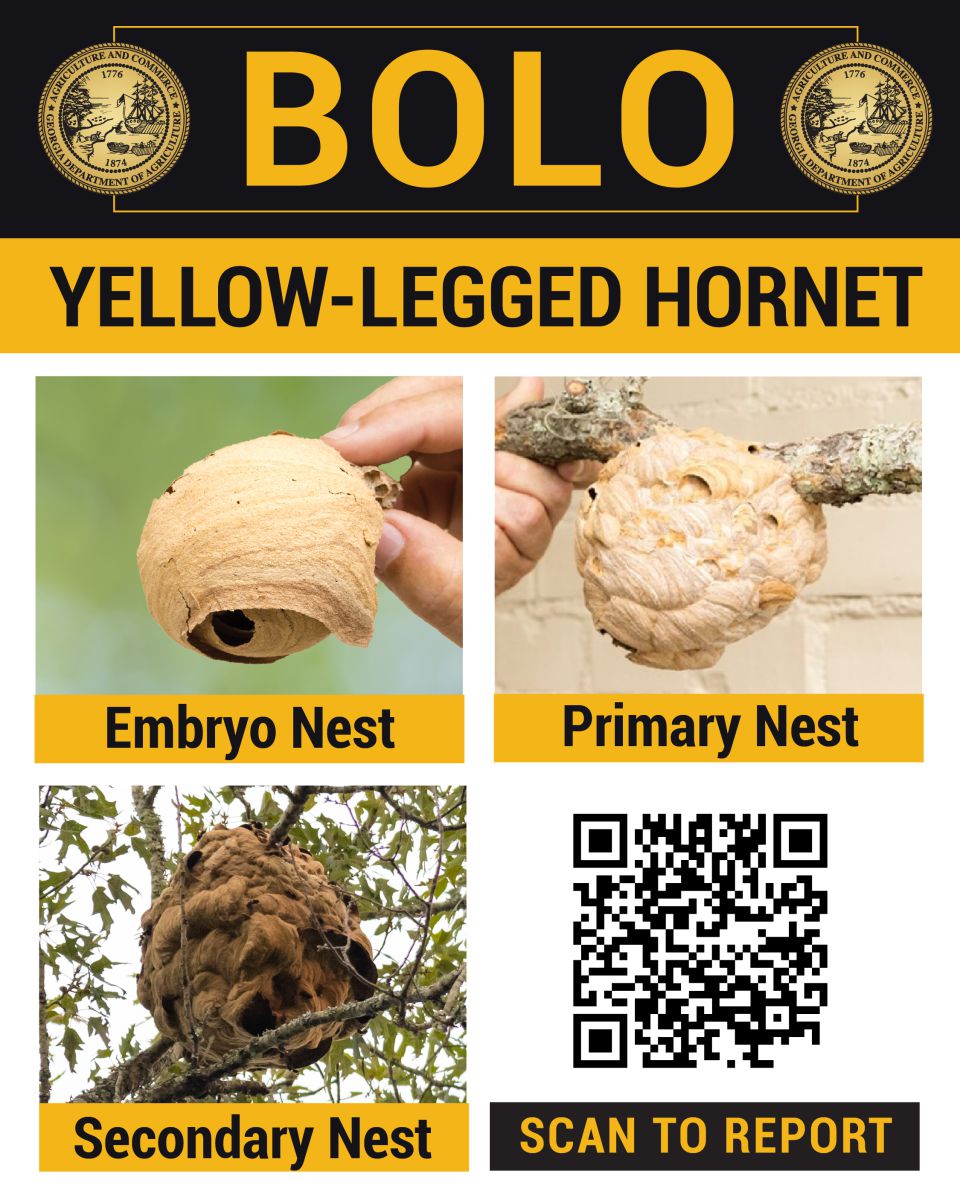
“Georgia has made significant progress in our effort to eradicate the Yellow-Legged Hornet, but public participation remains critical to our success,” said Agriculture Commissioner Tyler Harper. “Every embryo or primary nest reported and removed today helps prevent larger infestations tomorrow. We need Georgians to stay alert and report suspected nests to help protect our pollinators and Georgia’s number one industry—agriculture.”
Early detection and removal of these nests is critical to preventing the development of large secondary nests later in the season. A single undetected primary nest can produce a secondary nest containing thousands of hornets and multiple reproductive queens capable of establishing new colonies. This poses a significant threat to honeybees and other pollinators that support Georgia’s agricultural industry.
What Georgians Can Do
Stay Alert: Embryo and primary nests are often found in trees, shrubs, eaves, and other elevated locations around homes, businesses, and wooded areas. Watch for hawking activity around beehives, particularly during the morning hours (before noon) and after 5 p.m. Hawking activity around bee hives indicates the hornets are entering their secondary nesting phase. Hawking occurs when the Hornets hover near honeybee hives and prey on foraging bees.
Look for large, round or oval-shaped secondary nests high in trees or other elevated locations. Secondary nests are typically gray or brown and made of layered, paper-like material. Depending on temperatures, they may be visible from late summer through winter.
Report Suspected Nests: If you believe you have found a Yellow-Legged Hornet or an embryo, primary or secondary nest, contact the Georgia Department of Agriculture’s Plant Protection Division at yellow.legged.hornet@agr.georgia.gov to ensure the nest is properly identified and the queen is eradicated.
For more information about the Yellow-Legged Hornet and how to identify potential nests, visit https://agr.georgia.gov/yellow-legged-hornet.
- Categories:
- Tags: