Ag News
GFB hosts event for farmers to discuss ag issues with USDA's Vaden
Posted on Apr 08, 2026 at 15:42 PM
Georgia Farm Bureau hosted a roundtable April 7 for USDA Deputy Secretary Stephen Vaden to meet with Georgia farmers from across the state to discuss the economic pressures they are facing. Key topics included record-high input costs (fertilizer, fuel, equipment, seed, and pesticides/herbicides) that are outpacing the prices they are getting for their crops.
The group, which met at Southern Belle Farm in Henry County, also discussed crop insurance and poultry issues.
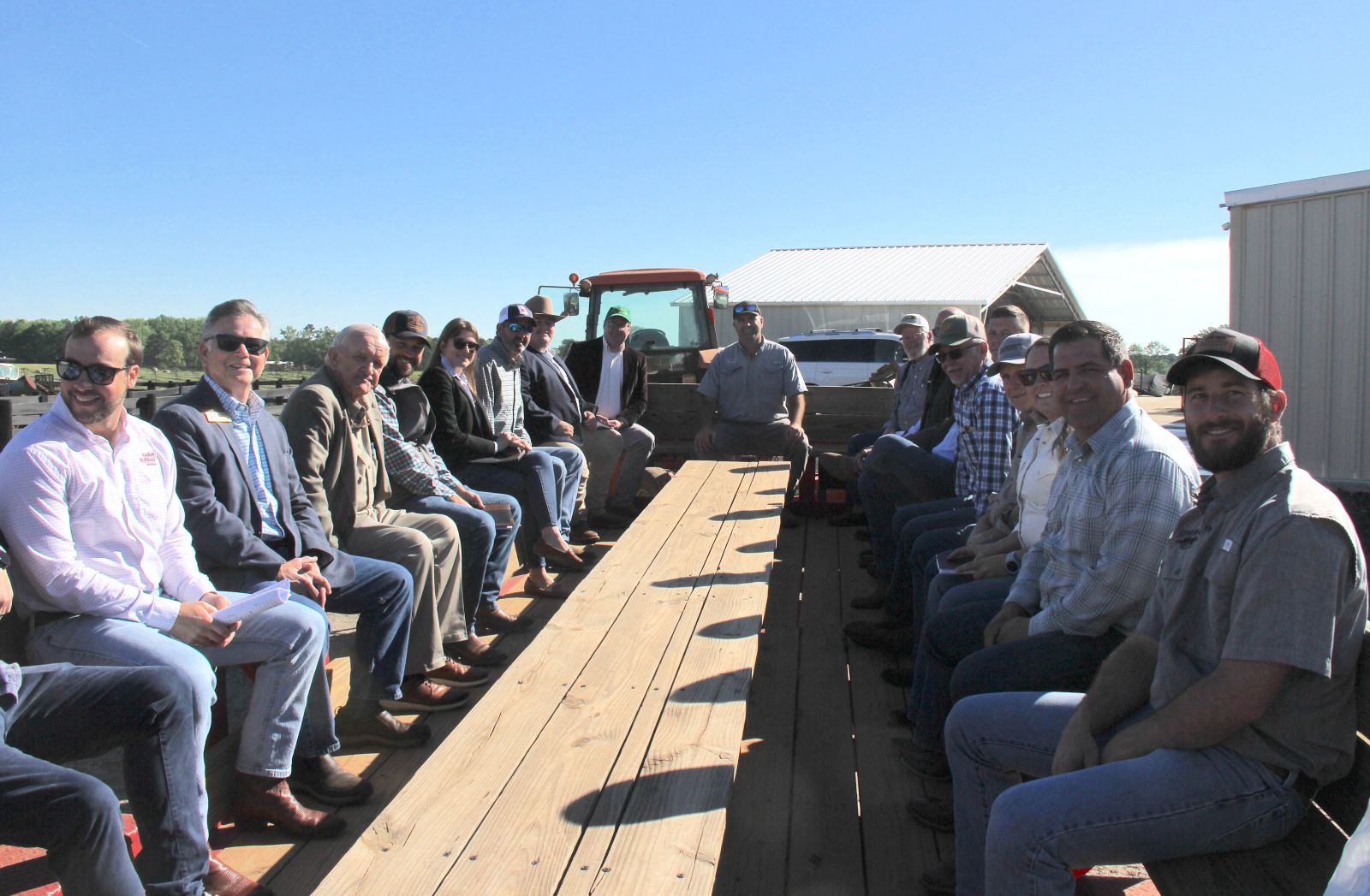
Henry County Farm Bureau Director Jake Carter, top center, gave those attending the roundtable with USDA Deputy Secretary Stephen Vaden that GFB held at Carter’s Southern Belle Farm, a tour of the farm’s strawberry, muscadine and peach orchards. Photo by Jennifer Whittaker
GFB appreciates all the farmers who took the time to attend, especially those who made the long drive from Southeast and Southwest Georgia during planting season. GFB also thanks Henry County Farm Bureau Director Jake Carter for providing his farm as the venue.
“The biggest thing that we as producers and Farm Bureau worry about is the sustainability, the profitability of our farms. If farms aren’t profitable, they aren’t sustainable and I don’t know what we’re doing this for,” GFB President Tom McCall said when kicking off the discussion. “America being able to feed itself is a national security issue as much as the military. You only need five things to survive – food, clothing, shelter, air and water. Three of them come from agriculture and God gives you the other two. That’s the importance of agriculture, not only in Georgia but in the whole country. When farms in our rural communities start fading away, so do the hamburger joints, the grocery stores, the gas stations and the tire dealers. Thank you for coming today to hear from our farmers.”
Between the farmers attending, most of the state’s major crops were represented.
“We’re in trouble in the farm business. This will be my 43rd crop and this is the first time in my life that I’m thinking going into the crop year before I even plant that I probably won’t break even,” said Pierce County row crop farmer Daniel Johnson. “It’s not just fertilizer and fuel, it’s [replacement equipment] parts and equipment and all of the inputs. I keep hearing about tax breaks that will help save the farm, but if something doesn’t turn around pretty fast there isn’t going to be a farm to save.”
Consolidation of ag supply companies one reason for high costs
Vaden, who is the second-highest ranking official at the USDA, helps oversee implementation of federal ag policy nationwide. He previously served as USDA general counsel during President Trump’s first administration, leading the department’s legal strategy on major regulatory and policy issues. As a former judge on the U.S. Court of International Trade, he handled cases involving trade law, tariffs and global commerce. His early career included work on international trade and ag policy with a focus on market access and the global competitiveness of U.S. agriculture.
Vaden said he spends a lot of his time focused on input costs and looking at the broader market dynamics. He said USDA data shows that from the early 1970s to about 2010 that commodity prices and input costs were correlated.
“You start out in the early 1970s and you go all the way to roughly the 2010s, those two lines [input costs and commodity prices] clearly correlate. It’s not perfect, but there’s a clear relationship where, when commodity prices rise, so do the input costs and when commodity prices decline, the input costs follow,” Vaden said. “About the 2010s or so those two lines diverge, and the input costs have become steep. They [input costs] no longer follow the commodity prices like they did before. If you look back at what was going on in that time period, it happens to correlate with the number of large mergers that took place, particularly in the agricultural sector. You’ve still got all the brands that you bought for decades, they just are now owned by about three companies in each sector. We think fewer people competing for your business and the growing prices are related.”
Vaden said the U.S. Department of Justice and the Federal Trade Commission are looking into whether some companies that sell ag inputs are following antitrust laws. He said the three big fertilizer companies are being investigated and that the Federal Trade Commission is suing farm equipment companies over farmers’ right to repair their own equipment with advanced technology or to choose their mechanic instead of being forced to rely on the equipment company’s mechanics.
During the meeting, Screven County row crop farmer Ben Boyd said he received a text after leaving home yesterday morning informing him that his fertilizer prices were going up another 10%. After the meeting, Boyd told GFB media that his fertilizer costs have increased from 55 cents/pound to 96 cents/pound since the beginning of planting season.
“Can you think of any other thing that is traded, supposedly in an open market, where somebody can give you a call and say ‘Here’s what the price is now. If you don’t buy now, here’s what it’s going to be. Later, it’s going to be higher, and they can tell you what it’s going to be, and then it will be even higher than that, and [they] say that with surety, and it’s a commodity?” Vaden asked. “No, you can’t and so that raises questions, which is why the Department of Justice and why the Federal Trade Commission is looking at it. This is an administration which is focused on the ag supply chain. There are two separate executive orders signed by the president ordering the DOJ and the Federal Trade Commission to look into these markets.”
Both Boyd and Thomas County row crop farmer and cattle producer Julie Hardy expressed concern that ag companies are charging farmers as much as they possibly can.
“Every time I fill out the credit applications for our farm to the companies we buy our inputs from, every single one of those companies want to know not only our financial information, they want to know how many acres of what crop we’re planting and what our expected yield is,” Hardy said. “Even when we got the Bridge payments that were to help farmers since a farm bill hadn’t been passed since 2018 to update reference prices to account for higher production prices, they raised their prices. Don’t get me wrong, we needed the Bridge payments and we’re thankful for them, but it’s just they know what they can charge us because they finance everything.”
Farmers express concern another Bridge payment may be needed
Grady County peanut and cotton grower John Harrell also expressed appreciation for the Bridge payments issued last year to help farmers stay afloat in the face of high input costs and low commodity prices but warned another round of payments may be necessary.
“Deputy Secretary, I appreciate you and the Secretary and the Trump administration for that bridge payment. I've talked to my banker and several other bankers and farm credits, and all of them say that without that bridge payment, and without provisions in the One Big Beautiful Bill that will increase our safety net come this October, they could not have financed a lot of farmers this year,” Harrell said. “Of course, you know, the price of everything is jumped up, so our bridge payment is basically gone now. I know [U.S. House Agriculture Committee] Chairman [Glenn] Thompson is wanting to do another bridge payment through the House and the Senate, and you know, I hope, that can be put on something [the pending farm bill or an appropriations bill] because I know what y’all are doing is going to help us in the future, but it’s like others have said, no business can operate losing money. The only thing keeping most of us afloat [with the banks] is the value of our land. I’m not making money. I’m just spinning my wheels.”
Crop insurance & chances of farm bill being passed
Lowndes County tobacco grower Fred Wetherington expressed gratitude to Congress and the Trump administration for including provisions in the One Big Beautiful Bill last July that lowered the cost of crop insurance. He asked if there’s a possibility the pending farm bill being considered by Congress could increase the maximum amount of a crop a farmer can insure from 75% to 90%.
“My same crop insurance that I had last year is costing about 20%, maybe 21 or 22% less this year than it did last year, so I want to thank you for that,” Wetherington said. “Trying to be a solutions-oriented person, I am just wondering could we maybe buy crop insurance to cover up to 90% of our crops? Buying crop insurance is a way that lets farmers stand up more on our own going forward.”
Wetherington experienced crop losses to both Hurricane Idalia in 2023 and Hurricane Helene in 2024.
Vaden said he thinks there’s a 40-60% chance Congress will pass a new farm bill this year and encouraged Farm Bureau members to keep pressure on their representatives and senators to pass it.
“I want to thank you for pointing out that the One Big Beautiful Bill, such a large portion of what was in that package was what would have normally gone in the farm bill, and it should have been done a couple years earlier,” Vaden said. “I think one of the great things about this new push for a farm bill is that we can make additional changes to programs, whether they be our Farm Service Agency loan gaps, whether they be crop insurance, whether they be our Natural Resources Conservation Service, or other programs that you can’t do through reconciliation because of the procedural rules that the Senate has. Now that you have a version that has passed out of committee in the House of Representatives, you have Chairman Bozeman from the Senate Agriculture Committee saying he intends to mark out the farm bill in his own committee. I understand that the House of Representatives may be moving toward a floor vote in the not-too-distant future on a farm bill, and the president has come out on his social media account, and also at Ag Day, saying he expects to be able to sign a farm bill.”
Also attending the roundtable were Abby McHan, a native of Calhoun, who is Vaden’s senior advisor, and Greg Ziesenhene, field director for U.S. Rep. Mike Collins.
- Categories:
- Tags: