Ag News
GFB YF&R, Leadership GFB programs visit Washington, D.C.
Posted on Apr 22, 2026 at 13:05 PM
Two key groups in Georgia Farm Bureau’s leadership development programs visited Washington, D.C., April 14-17 for training and advocacy activities.
A group of 25 GFB members from 20 different counties went as part of the GFB Young Farmers & Ranchers (YF&R) program, and the 12 members of the inaugural Leadership GFB class visited concurrently.
The YF&R group received briefings from American Farm Bureau Federation (AFBF) staff about the farm bill and international trade, as well as advocacy training. The advocacy training on April 14 walked the YF&Rs through a visit with a policy maker, exploring the importance of advocacy and a framework for delivering concise messaging both asking for and offering help.
“It’s a great time to be able to sit down in front of a congressperson or a staffer, to let them know that [agriculture] exists,” said GFB YF&R Committee Chairman Garrett Hurley. “Basically, [we] just took our seat at the table, because ultimately if we don't take that seat, someone that’s sitting in front of us will tell a story that is possibly not true. And we want to be sure that we've got the true Georgia agriculture story in front of these legislators.”
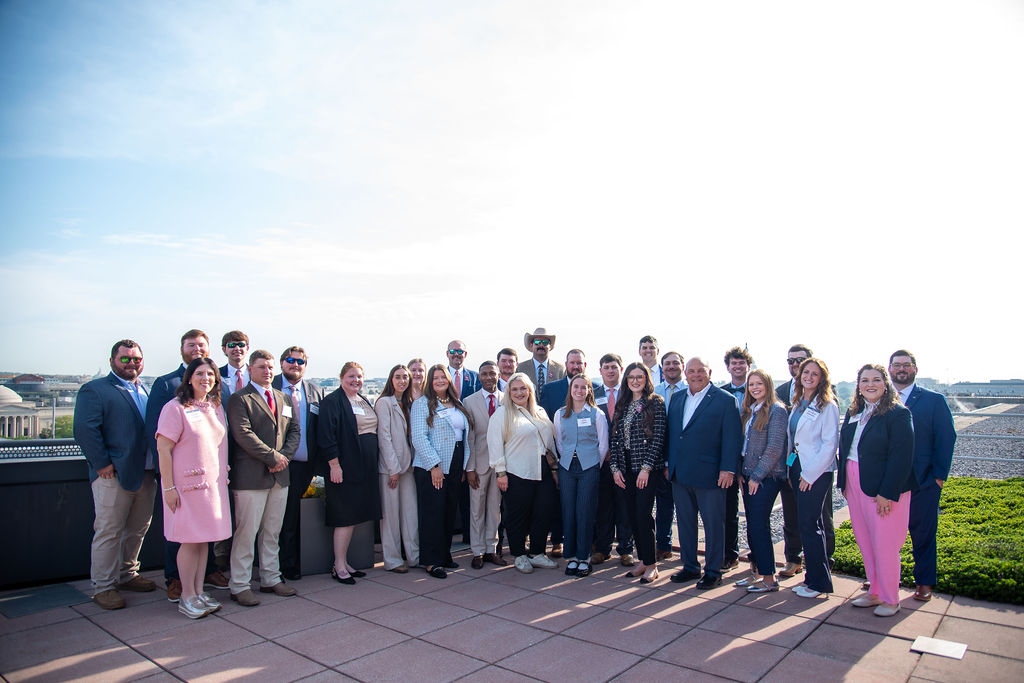
Members of Georgia Farm Bureau's Young Farmers & Ranchers program visit with American Farm Bureau President Zippy Duvall during their trip to Washington, D.C., April 14-17. Photo by Logan Thomas
On April 15, the YF&R group visited 10 members of Georgia’s congressional delegation, with whom they shared the dire situation Georgia farmers find themselves in. Key messaging centered on getting a new farm bill passed. The YF&Rs told elected officials and their staff about the overwhelming challenges presented by spiking fertilizer and fuel costs.
“I don't think there's ever been a time that it's been more important to come up here to D.C., to talk to these legislators and let them know how bad it really is back home and hopefully get some support from them, to help the Georgia farmer, also the American farmer, be sustainable.” Hurley said.
The YF&R group had opportunities to explore D.C., and their trip included visits to the French Embassy and the Pentagon on April 16. At the French Embassy, Counselor for Agriculture Christian Ligeard presented information about farming and ranching in France, which farms a total of 66 million acres and accounts for 18% of agricultural production in the European Union.
France is tops among EU nations in wine production in terms of value and second in volume. In 2024, France exported $6.8 billion worth of agricultural goods to the United States:70% of that was wine. France is the EU’s fourth-largest producer of fruits and vegetables.
Like their counterparts in the U.S., French farmers are being squeezed with respect to input costs and product prices, Ligeard said. He referenced policy “mirroring,” referring to the concept of having producers of goods that are imported to France subject to the same production standards and regulations as French farmers. And like U.S. farmers, French producers would like fewer regulations.
Netherlands Embassy, EPA, Farm Tours highlight Leadership GFB trip
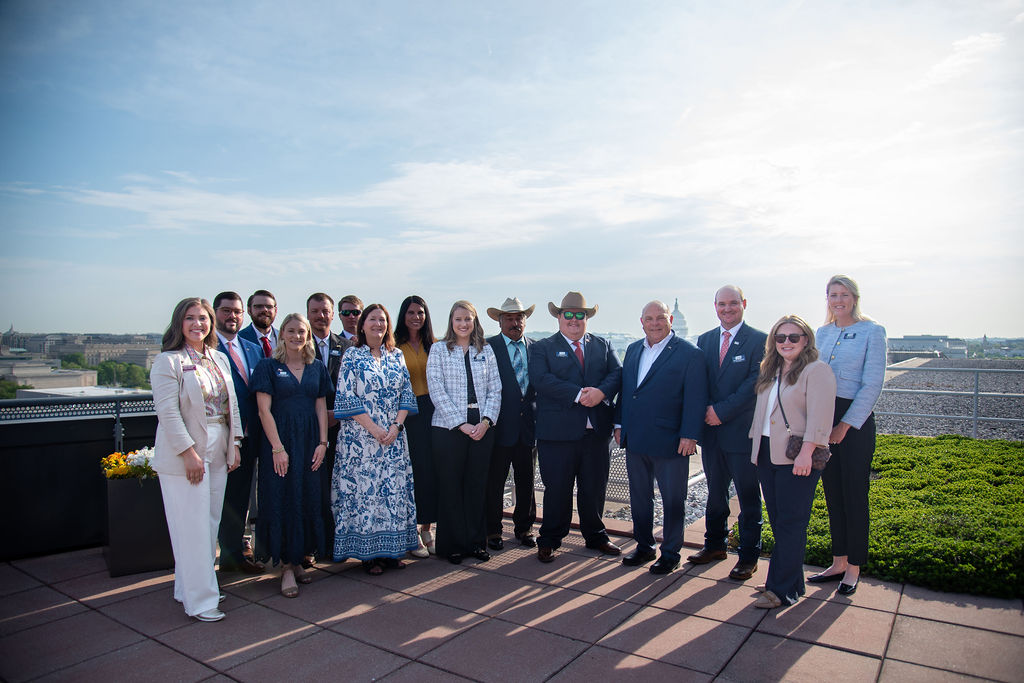
The inaugural Leadership GFB class visits with American Farm Bureau President Zippy Duvall during a trip to Washington, D.C., April 14-17. /Photo by Logan Thomas
Leadership GFB members visited the Kingdom of the Netherlands Embassy on April 14 and were given an overview of Netherlands agriculture and how it compares to U.S. agriculture. Netherlands Agriculture Counselor Ton van Arnhem, Agricultural Attaché Mark Zonnenberg, and Agricultural Advisor Caroline Feitel shared information about the Netherlands’ use of controlled environment agriculture, greenhouse exports, and trade between the U.S. and The Netherlands. Notably, cost of land, input costs, and barriers to entry for young farmers are problems that both U.S. and Dutch farms are facing.
“Agriculture for them looks very different than it does for us,” said Leadership GFB participant Toni Gaines. “They're able to do a lot with a little bit of space. For me, it was a little bit eye-opening. If they can grow tomatoes there year-round, why can’t we do that in America and supply enough tomatoes and from greenhouses in this country where you don’t have to go to the grocery store and see Mexico tomatoes in December?”
On April 15, AFBF Senior Director for Advocacy & Media Training Johnna Miller guided the Leadership GFB group through the process of interacting with media outlets.
Miller encouraged Leadership GFB to focus on shared values, steer clear of agriculture industry jargon and acronyms, and to use positive wording when speaking with the media. She trained members to think about sound bites that can be used from interviews, don't wait for the question, and to not be afraid to ask questions to reporters to prevent being caught off guard.
“My big takeaway from media training is be careful with your words and also not use terms that are so familiar to us in the industry,” Gaines said. “If you go out there and you say, ‘Oh, I’m a cattle producer,’ they don't know. Just say you're a farmer and keep it simple.”
Leadership GFB visited the Environmental Protection Agency (EPA) and heard from EPA Senior Advisor for Agricultural and Rural Affairs Turner Bridgforth, who discussed ways that the EPA is working with farmers to expand tools to help fight disease and pests.
Bridgforth said he is using his agriculture background to help lawmakers, staffers, and EPA officials understand farmers and how decisions affect them. He said it is important to get people from the Make America Healthy Again (MAHA) movement onto local farms to bridge the disconnect between MAHA and much of conventional agriculture.
On April 16, the Leadership GFB group visited four farm operations in Northern Virginia, through coordination with Virginia Farm Bureau. The tours included stops at Great Country Farms near Bluemont, Virginia, Gathering Springs Farm in Middleburg, Mom’s Apple Pie bakery in Loudon County and Potomac Vegetable Farm in Vienna/Purcellville.
At Great Country Farms, the group met with farm operator Kate Zurschmeide at the 400-acre farm near the base of the Blue Ridge Mountains. Great Country Farms offers produce and the farm experience to its customers.
The group met Pamela Jones and Sarah Obuchowicz at Gathering Springs Farm, a small farm that grows more than 60 varieties of fruits and vegetables and cut flowers. The farm has 200 pasture-raised laying hens on two acres of land. The farm operates primarily through community-supported agriculture (CSA), selling at farmers markets and a direct-to-consumer stand on the farm.
Loudoun County Farm Bureau president Avis Renshaw hosted Leadership GFB at her bakery, Mom’s Apple Pie. She discussed issues that Loudoun County, which she called the richest county in the nation, is facing: Data centers, developers, land prices, water usage many of the same issues Georgia farmers face. She and her husband grow all the fruits used in her pies at the bakery.
On the final tour stop, Leadership GFB met with Hana Newcomb at Potomac Vegetable Farm, which has been in operation for over 50 years in the middle of the Washington, D.C., suburbs. They sell all of their produce through CSA boxes, roadside stands and farmers markets.
- Categories:
- Tags: