Ag News
GFC Director Sabo shares good news for forestry
Posted on Aug 19, 2026 at 14:42 PM
Although Georgia’s forestry sector has had a tough year with multiple timber mills closing, a record number of wildfires statewide, and international trade issues, while speaking at the Georgia Farm Bureau Commodity Conference in Tifton on Aug. 13, Georgia Forestry Commission (GFC) Director and State Forester Johnny Sabo pointed out some of the positives the industry has going for it.
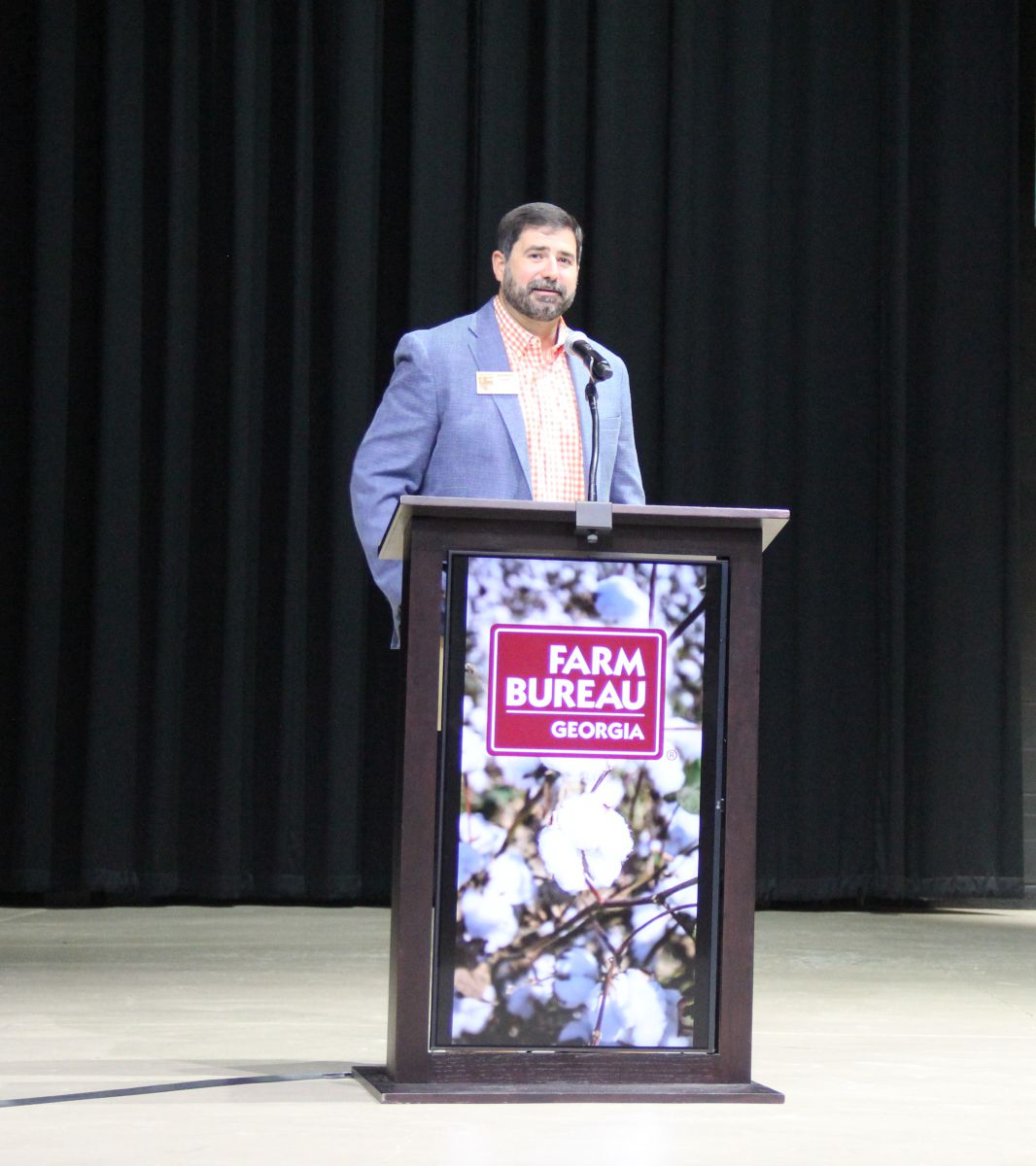
Sabo, pictured above speaking, said GFC is working with the Georgia Department of Agriculture’s Georgia Grown program and the Georgia Forestry Foundation to roll out a marketing campaign for Georgia Grown Wood. /Photo by Jennifer Whittaker
“Georgia Grown Wood is a marketing campaign that’s in partnership with the Georgia Department of Ag and the Georgia Forestry Foundation. The Forestry Foundation is really taking a lot of the lead on it. We envision that you will soon be able to walk into Lowe’s or Home Depot and look for the Georgia Grown Wood logo to buy products grown in our state,” Sabo said. “The Georgia Grown Wood logo will help you buy Southern yellow wood versus spruce or something else coming out from Canada.”
Sabo said thanks to funding the Georgia General Assembly approved, a new GFC county office being built in Morgan County to serve Greene and Morgan counties will be a mass timber building. The state budget included $2.6 million for design and construction of the building.
“It will be the first mass timber building built by the state, not by a private entity, that Georgia has ever had,” Sabo said. We received our civil engineering [specs] back. We’ve already got the architectural plans done. It will be built with all Georgia Grown Wood, so that’s something we’re really excited about.”
The Georgia Forestry Innovation Initiative (GFII) is also working with Georgia Tech to develop new products that use small diameter wood, Sabo said. The GFII, created this year with an $8.9 million investment allocated by the Georgia General Assembly, is being overseen by the GFC in partnership with Georgia Tech, to develop and manufacture high-value products from pulpwood class trees and sawmill residues.
“We’re not talking about aviation fuel or biochar - things that have been around for years. We’re talking about pharmaceutical coatings and other things that have previously been petroleum based,” Sabo said. “Georgia Tech chemists and scientists say they can make that [pharmaceutical coatings] out of lignin, and so this is the state de-risking it for industry, for at least an industry partner, and scaling it up and working with what Georgia Tech calls the EIS American Market Analysis Group and trying to trying to find uses for small diameter wood, which we know we’re all struggling with in the industry.”
Sabo also discussed the two major wildfires Southeast Georgia experienced from April into June.
He said the Pineland Road Fire that started April 18, burned a total of 32,031 acres before being contained on June 10. The fire destroyed 35 minor structures (hunting camps) and had 272 personnel fighting it at its peak. The total cost of fighting this fire was just shy of $15 million, Sabo said.
The Highway 82 Fire, which began April 20, burned 22,410 acres before being contained on June 10. This fire destroyed 110 homes and 16 minor structures and damaged 27 homes and 20 minor structures. On the positive side, firefighters were able to save more than 350 homes, Sabo said. At the fire’s peak there were 632 personnel fighting it from 35 states representing 100 fire departments and 7 hand crews. The cost of fighting this fire was just under $20 million, Sabo said.
“I cannot thank our partners enough from all over the nation, especially from Florida that came to help us,” Sabo said. “They came to help us, and we want to go help them. We’ve deployed about 140 personnel. To put that in perspective, a little over 300 personnel have gone from all the 13 Southeastern states collectively. We have a 42-person team sitting in Eastern Oregon right now, at the Shingle Fire, the largest one they’re managing. We also have some of our engines in South Dakota. We will help people where they need help because we know that we rely on them to help us as well.”
- Categories:
- Tags: