Ag News
Public policy: Cultivate relationships and make sure you vote
Posted on Aug 19, 2026 at 14:57 PM
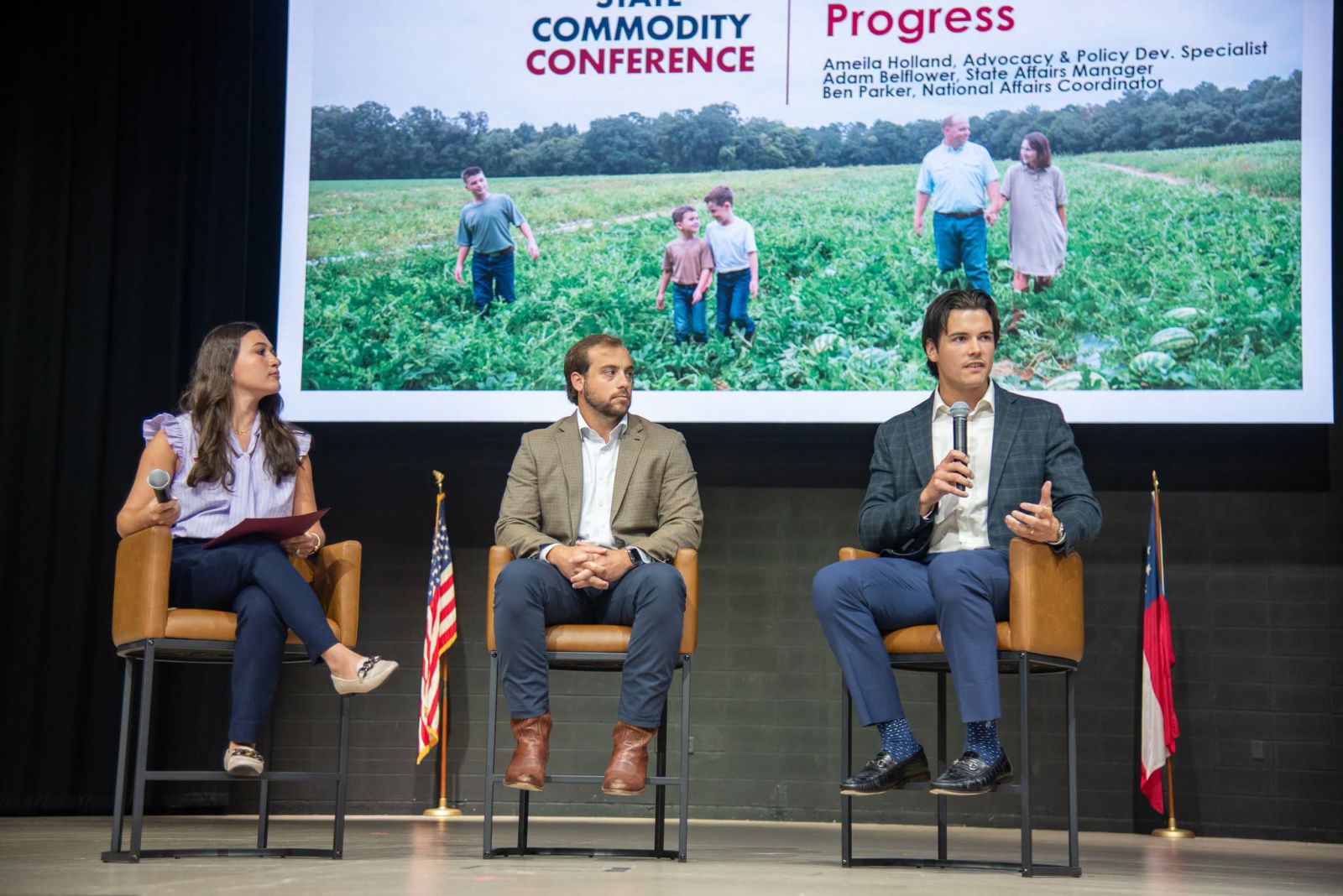
During the general session at the 2026 Georgia Farm Bureau Commodity Conference, GFB Public Policy staff members, pictured from left, Amelia Holland, Ben Parker, and Adam Belflower, discussed how they work to help achieve organizational goals and what role GFB members play in the policymaking process. / Photo by Logan Thomas
Their two main messages: Relationships matter, and good public policy begins at the ballot box.
“Every vote matters,” said Holland, who heads up GFB’s I Farm. I Vote. initiative. “Every voice matters. We’re going to keep working for you guys and we certainly hope you’ll join us in this effort to keep agriculture at the front of all these decisions being made in Atlanta and D.C.”
Both Belflower and Parker pointed out policies that started with Farm Bureau and ultimately came to be.
Belflower, GFB’s state affairs manager, noted that in recent years, the GFB Commodity Advisory Committee for Hay voiced a need to have a UGA Extension forage specialist for North Georgia. Based on this input, GFB members and staff pushed the state legislature to provide funding to support a forage specialist position, and this spring, the legislature did so. The new forage specialist for North Georgia, Justin Burt, was recently hired.
Parker noted that a similar effort involving multiple states contributed to the development of the Securing Agriculture’s Workforce Act (H.R. 9535), which was introduced in Congress in June by House Agriculture Committee Chairman Glenn “GT” Thompson with 57 cosponsors, among them Reps. Rick Allen and Austin Scott from Georgia.
“We took a very targeted approach this last policy cycle, looking at exactly what we want in an H-2A bill,” Parker said. “As a grassroots organization, we developed a policy that best serves those that it’s going to affect the most. Because we had buy-in across the country from various ag groups … we had a very easy time getting that put into a bill.”
Both Belflower and Parker indicated that Farm Bureau’s policy wins happen because members engage with elected officials.
“I think the biggest strength we have when it comes to membership advocacy is relationships,” Belflower said. “Politics are becoming more and more driven by social media. Relationships are more important than social media. When you want to influence policy makers and you want to be a part of the conversation and you want to be able to help shape policy and actually impact what gets across the finish line, you have to have a relationship with those members. Just going out and being an angry Twitter warrior, an angry Facebook person might get you attention, but it doesn't get effective policy across the finish line.”
The panel also went into how to cultivate those relationships:
Visit with elected officials – Congressmen, state legislators, local leaders – in person;
Invite them to visit and tour the farm;
Contact them when action a relevant issue is being considered.
Said Parker, “Once you’ve established that relationship, be loud.”
Emails alone are not enough.
“Emails are great, but if you never know what the person looks like or sounds like, then you just kind of have an automatically assigned voice to them in your head,” Parker said. “Getting that name and your face involved with whatever the ask is, coming with a very easy-to-remember narrative for them to spell out in committee hearings or just while they’re in the district. I think those things are really valuable, and we [GFB] do that very well.”
The panel addressed the coming mid-term elections, now less than 80 days away. The national mid-term elections – with one Senate seat and three House seats to be determined – garner massive attention, but the down-ballot vote in Georgia should not be overlooked.
All of the state’s constitutional officers – governor, lieutenant governor, secretary of state, attorney general, commissioners of agriculture, insurance and labor, and the state school superintendent – are to be elected in November, as is every seat in the Georgia General Assembly, 180 in the House and 56 in the Senate.
In the state elections, Belflower said, the races are closer than they’ve been in decades.
“It’s important that you make sure folks in your community realize they need to show up and vote, and that their vote is going to impact the direction of the state and not just their community,” Belflower said. “Advocacy starts at the ballot box. You’ve got to show up and vote and get good policymakers in those positions.”
Parker said polling shows every election in the state to be close and almost all of them are within the margin of error.
“I will say that it comes down to voter turnout,” Parker said.
- Categories:
- Tags: