Ag News
Rollins: Georgia meat processors inspected by GDA can ship nationwide
Posted on Aug 05, 2026 at 10:45 AM
Farmers from Carroll and surrounding counties, state ag leaders and Carroll County community leaders gathered at North Georgia Turf in Whitesburg, Ga., July 27 to discuss ag issues with U.S. Secretary of Agriculture Brooke Rollins and Georgia Commissioner of Agriculture Tyler Harper.
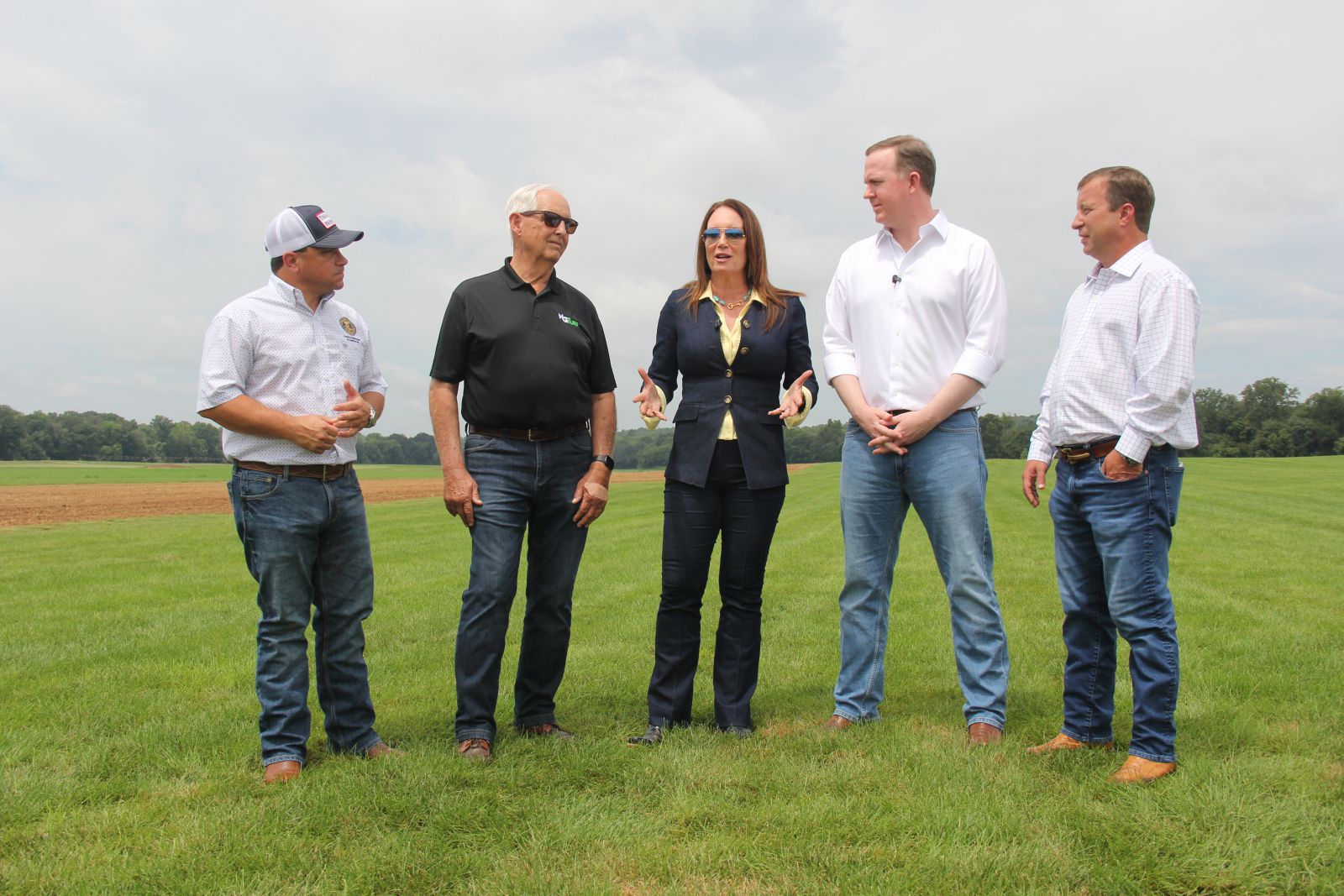
U.S. Secretary of Agriculture Brooke Rollins, center, shares her enthusiasm for visiting a sod farm for the first time as secretary of agriculture and getting to see the Sunbelt Blue sod North Georgia Turf is growing. Joining Sec. Rollins on her tour of the farm in Carroll County, were from left, Georgia Commissioner of Agriculture Tyler Harper, Aaron McWhorter, owner of North Georgia Turf, U.S. Rep. Brian Jack (R-Dist. 3) and Ga. Rep. Jutt Howard and North Ga. Turf vice president of business operations. / Photo by Jennifer Whittaker
Rollins and Harper announced in a press conference that the State of Georgia and the USDA have finalized a Cooperative Interstate Shipment (CIS) agreement, which will allow Georgia meat processors inspected by the Georgia Department of Agriculture to ship their products across state lines across the United States under the USDA inspection mark.
During a roundtable meeting, topics discussed included farmland conservation, labor challenges - especially poultry/boiler farms’ year-round need for workers and inability to use H-2A effectively; the tournament system under which poultry producers raise chickens and produce eggs; efforts the USDA is employing to eradicate New World Screwworm, and USDA’s plans to reopen the U.S. southern border to live Mexican cattle in phases beginning Aug. 24.
U.S. Rep. Brian Jack (R – Dist. 3) arranged Rollins’ visit to the family sod farm owned by Aaron McWhorter.
“It's very special for Carroll County to welcome the United States Secretary of Agriculture Brooke Rollins to Georgia's 3rd Congressional District. Agriculture is Georgia's number one industry, but also within our district, we are a key producer of timber, of sod, and of livestock,” Jack said. “We had the pleasure of doing a roundtable with some of the great agriculture leaders from West Georgia and heard from all sorts of folks from livestock to sod to timber.”
Rollins listens to farmers
Georgia Farm Bureau Middle Georgia Vice President Ralph Caldwell and GFB National Affairs Coordinator Ben Parker were among the farmers and agribusiness leaders attending the private roundtable meeting at the North Georgia Turf headquarters office.
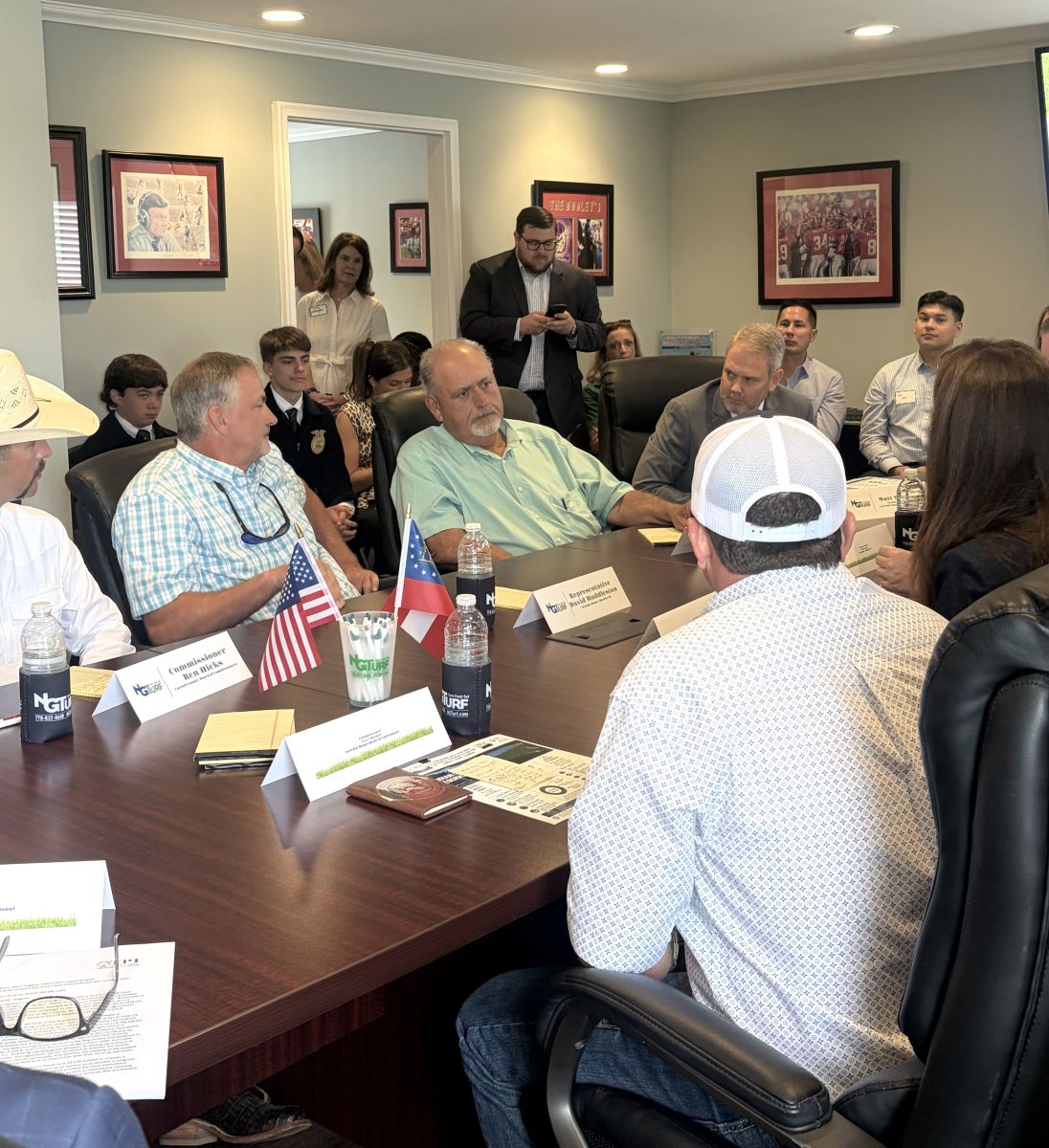
Georgia Farm Bureau Middle Georgia Vice President Ralph Caldwell, left side of table, center, participated in the private roundtable meeting held July 27 at North Georgia Turf in Carroll County. / Photo by Ben Parker
“It was a very good meeting. Secretary Rollins got to hear real issues from real farmers with mud on their boots,” Caldwell said. “She took notes and was very receptive to what we had to say.”
Caldwell, a poultry, cattle and hay producer in Heard County, shared the difficulties he has in finding reliable labor to work on his farm.
During a press conference held after the round table, Harper commended Rollins for the work she has done with the U.S. Department of Labor to reduce farm labor costs by over 30% since early 2025.
Caldwell also discussed concerns some poultry growers have with the tournament system under which they raise poultry for integrator companies, and the frustration Georgia timber owners have with the European Union Deforestation Regulation (EUDR) set to go in effect Dec. 31.
The EUDR will deny America access to European timber markets unless documented tracking confirms reforestation of timber. This regulation does not allow the harvest of timber for conversion into active pastureland or cropland, despite allowances for residential or solar development.
Georgia Farm Bureau is encouraging timber producers and landowners concerned about the EUDR to sign a letter the National Association of Forest Owners plans to send President Donald Trump to ask him to negotiate with the EU to have the U.S. reclassified within the regulation. To sign the letter, visit https://gfb.ag/EUtimberletter .
Georgia Cattlemen’s Association President David Huddleston also attended the roundtable and discussed cattle issues with Sec. Rollins including efforts to protect the U.S. cattle herd from New World Screwworm through the dispersal of sterile flies.
Georgia meat processors inspected by state can ship products nationwide
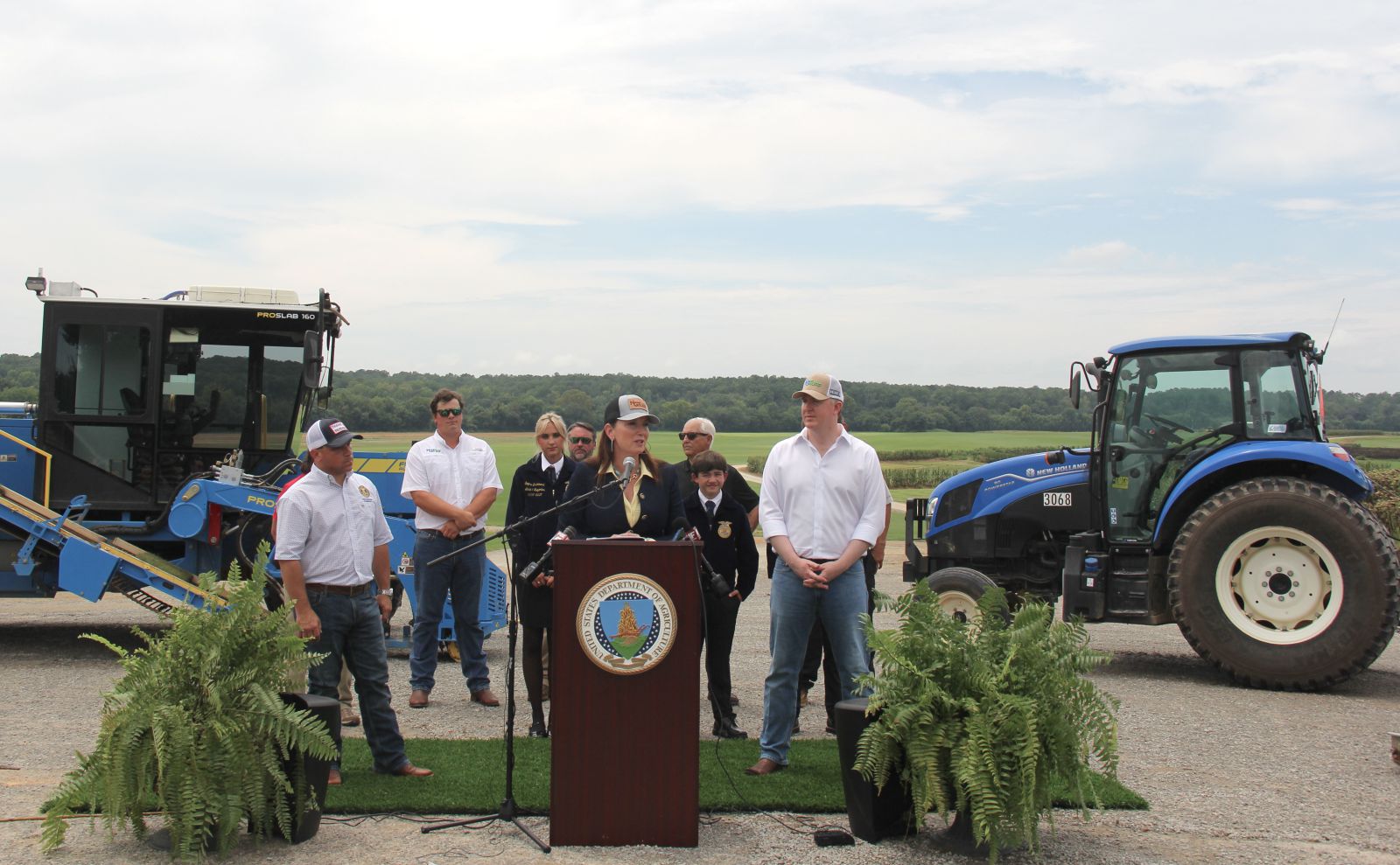
Following a tour of the sod farm, U.S. Secretary of Agriculture Brooke Rollins, at podium, and Georgia Commissioner of Agriculture Tyler Harper, standing at left, announced the State of Georgia and the United States Department of Agriculture (USDA) have finalized a Cooperative Interstate Shipment (CIS) agreement. / Photo by Jennifer Whittaker
“We have been very focused on the small and mid-sized [meat] processors in the Trump USDA [this] second time, and there are about 230 of those small processors here in Georgia. They are a critical piece of the puzzle as we continue to work to rebuild our cattle herd that is at a 75-year low. This is a huge opportunity for the 23 state-inspected plants here in Georgia, and certainly the Georgia cattlemen that rely on those 23 plants. As they [the processors] enter the CIS program, all 50 states would be open for their business.”
The CIS program was authorized in the 2008 farm bill and launched in 2012. The CIS program is limited to states that have established a State Meat and Poultry Inspection (State MPI) program. To be eligible, a State MPI program must demonstrate that the inspection it provides to participating state-inspected establishments is the same as the inspection the USDA Food Safety and Inspection Service (FSIS) provides at official federal establishments.
“By entering into this agreement, Georgia’s family-owned meat processors will now have the ability to access the same domestic marketplace as everyone else,” Rollins said. “Our ranchers have had to deal with a consolidated processing industry that has four companies, including two foreign owned, dominating 85% of the market. Today’s action takes a step toward leveling the playing field.”
Participating states must have the legal authority to administer and enforce requirements that are the same as the Federal Meat Inspection Act, the Poultry Products Inspection Act, and applicable regulations. The state must also collect regulatory samples at the same frequency as federal inspectors and use the same analytical methods at laboratories meeting the same level of accreditation as FSIS laboratories. FSIS provides ongoing oversight of the CIS program and reimburses states for 60% of the costs associated with providing this inspection service.
“We’re glad to be partnered with USDA on the Cooperative Interstate Shipment to move the needle in the right direction for our small processors,” Harper said. “We [the Georgia Department of Agriculture] are committed to protecting our food supply chain. That's what our team does every single day in our food processing and meat processing facilities across the state to ensure humane care, that our livestock is taken care of and that our farmers get a fair shake in the marketplace.”
In addition to Georgia, FSIS has signed CIS agreements with Indiana, Iowa, Maine, Missouri, Montana, North Dakota, Ohio, South Dakota, Vermont, and Wisconsin. For more information about CIS, visit www.fsis.usda.gov/cis.
Update on trade efforts
During the press conference, Rollins said the Trump Administration has secured 20 new trade deals as it works to open markets around the world to U.S. ag products.
“We’re expecting to set records for corn and ethanol and tree nuts and dairy just in this year alone. And most of those, that is a very important driver in Georgia. We need to open up the markets here in America, the domestic markets with biofuels and other things, which we’re seeing. We’ve also got to get the cost of inputs down in fuel, in fertilizer, in seeds, in equipment, in interest rates, and even in buying property. We have a plan for each of those that we’re implementing. Fertilizer is a great example. We used to produce almost all of our own fertilizer in America. With dozens and dozens and dozens of companies, now you’ve got basically four main companies. Half of them are not even American-owned that control the American fertilizer market, and so there’s no price competition. We’ve got to change that. We’re investing significant funds in new fertilizer production.”
Rollins said a new ammonia plant will soon be built in Louisiana that will be among the largest ammonia plants in the world.
House approves additional farm aid in budget bill
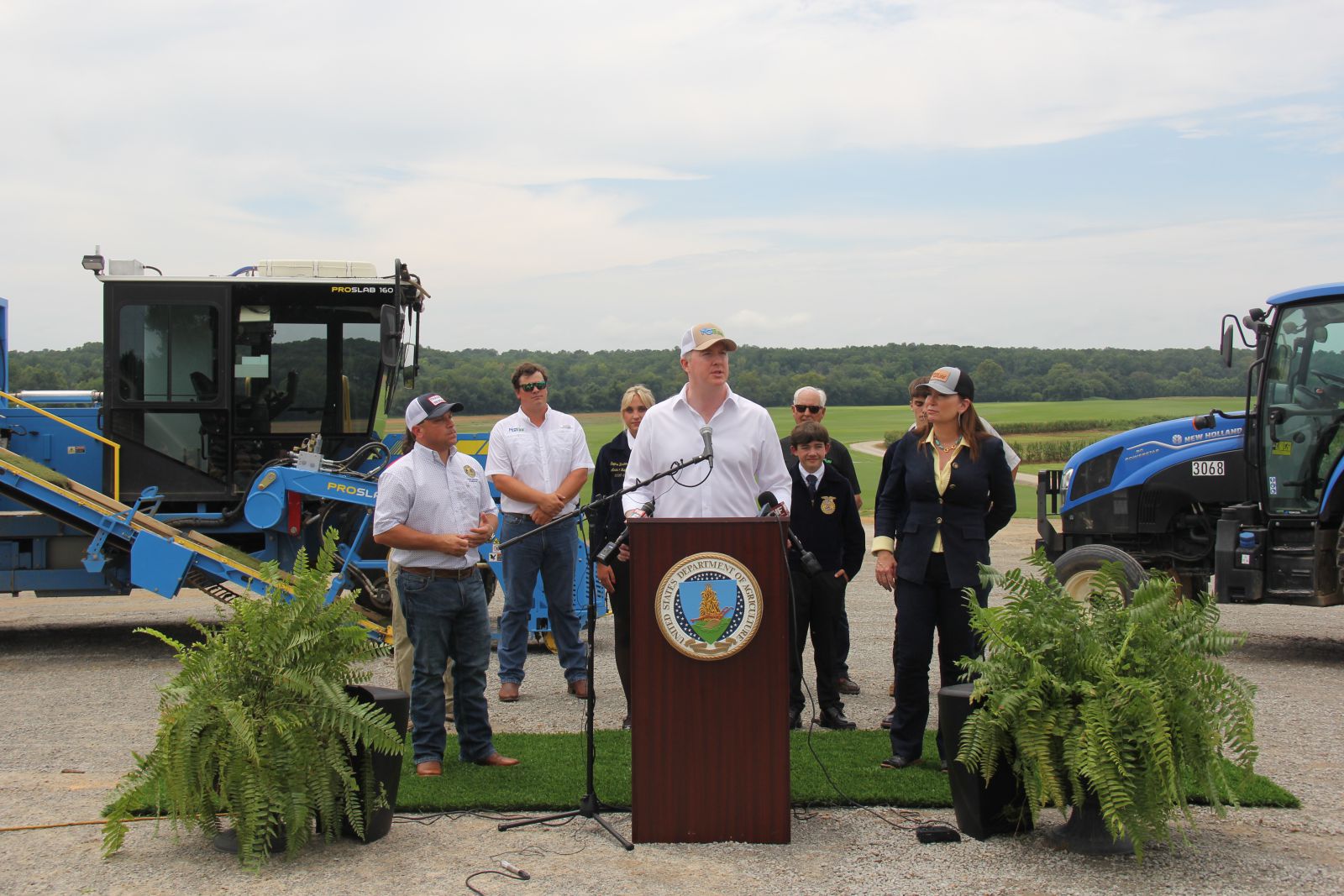
While speaking at the press conference held for Sec. Rollins’ visit, Rep. Jack, at podium said he voted for the $95 billion budget reconciliation bill that includes $12 billion in assistance for farmers to help them counteract higher production costs. The House passed the bill by a 216-214 vote on July 22. / Photo by Jennifer Whittaker
“Earlier this year, I was proud to cast a yes vote for the 2026 farm bill,” Jack said. “Last week we passed a budget reconciliation bill, and I’m proud to report I cast a yes vote for that.”
Farm Bureau says the additional aid is needed to help farmers weather the challenging farm economy.
“Several years of high inflation, low commodity prices and rising production costs have left many family farms facing another year of projected losses, with little path back to profitability,” American Farm Bureau President Zippy Duvall said. “Farmers are already making decisions for next year’s crop. Without timely assistance, more farm families and rural communities will feel the impact. Congress has an opportunity to help strengthen the farm economy by providing timely market relief before their summer recess.”
The House also passed a continuing resolution to keep the federal government funded after the current fiscal year ends Sept. 30, extending FY26 funding levels through Dec. 4. On Aug. 3, the Senate voted 89-4 to debate its version of a stopgap spending bill to keep the government funded through Dec. 11.
The House reconciliation bill needs only a majority vote to pass the Senate but because it includes several contested voting policies, multiple mainstream media outlets have reported that the bill’s chances of passing the Senate aren’t certain.
While the House broke for its August recess on July 24, at press time the Senate remains in D.C. addressing spending legislation, nominations and other administration priorities.
- Categories:
- Tags: