GFB News Magazine
Cotton Jassid: little bugs, big problem
by Jay Stone
Posted on March 1, 2026 12:18 AM
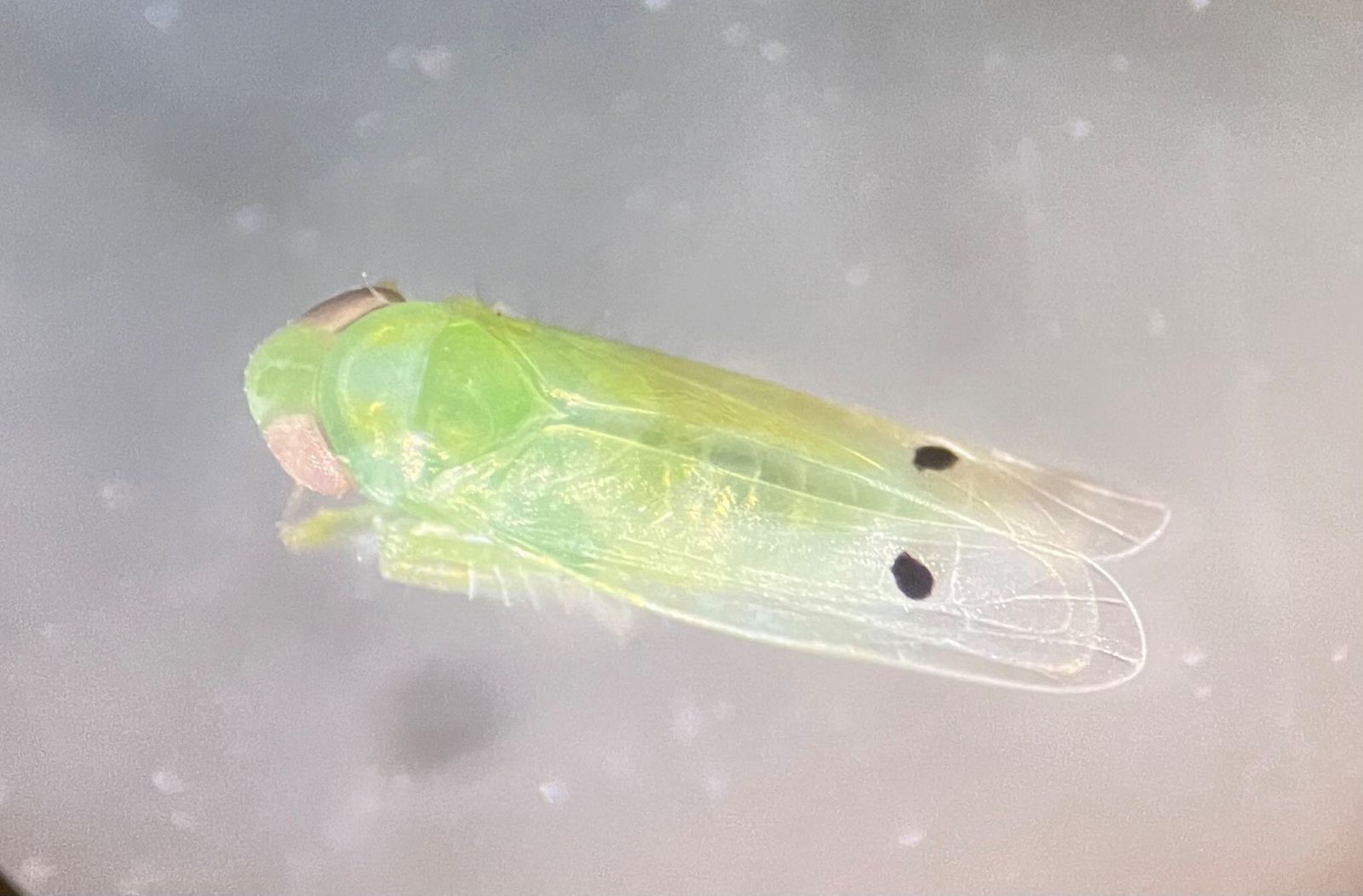
The cotton jassid, or two-spot leaf hopper, was first detected in Georgia in July 2025. / Photo by Justin Odom, UGA
A new insect invaded Georgia cotton fields last year. The adult cotton jassid is about three millimeters long, approximately the size of the word “WE” on the heads side of a penny.
As with most insects, its strength is in numbers. A female jassid lays between 14 and 60 eggs over her lifetime. A laid egg reaches adulthood in about two weeks. Once fully grown, an adult may live for two to six weeks.
Jassid populations expand rapidly, and South Georgia cotton farmers can attest to the damage the insects can do. Cotton jassids have also been found in ornamental nurseries in South Georgia.
“There’s still a lot of things that we need to better understand,” said UGA Extension Entomologist Dr. Phillip Roberts, who presented the latest available information on jassids at the 2026 Georgia Cotton Commission Annual Meeting, Jan. 29. “When you have something that turns a generation that quickly, you can see how populations can really go up. We all saw that across the state of Georgia [last year].”
Spread of the pest
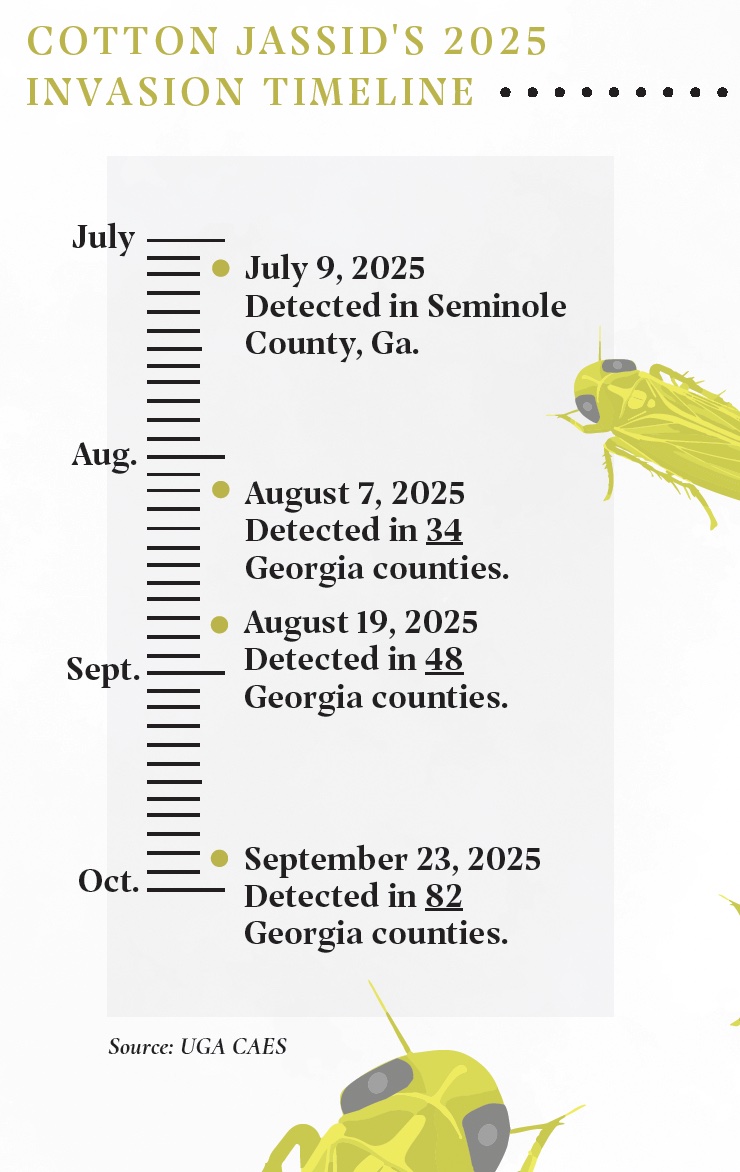
The tiny insects are native to the Indian subcontinent. In 2023, they first appeared in the Western Hemisphere in Puerto Rico. They were detected in Florida in 2024. Jassids were first detected in Georgia on July 9, 2025, in Seminole County. By Aug. 19, they had been found in 48 counties across Georgia’s Coastal Plain, as far north as Burke County, including most of the state’s cotton-producing counties. By Sept. 23, they were present in 82 counties, including nearly all of the coastal plain and as far north as Gordon County.
Effect on yield
The jassid, sometimes referred to as the two-spot cotton leafhopper, reproduces on at least 25 plant species including cotton, okra, sunflowers, eggplants and hibiscus.
.jpg) . Cotton jassids on the underside of a cotton leaf./ Photo courtesy of UGA
. Cotton jassids on the underside of a cotton leaf./ Photo courtesy of UGA
Okra appears to be their preferred host for reproduction. Roberts said the insects insert their eggs into plant tissue, making them difficult to see. In the course of feeding off the leaf, jassids introduce a toxin that researchers are still trying to identify.
This toxin causes “hopperburn,” which is characterized by puckering of the leaf tissue and the leaves turning yellow, red and brown. The damaged leaves become less efficient at photosynthesis, resulting in reduced yield.
On average, Georgia cotton producers who had jassids in 2025 saw crop yield losses of 2%, Roberts said. Early detection and pesticide application largely kept the insects under control. Left untreated, the potential damage and resulting yield loss is more extensive. Research trials where jassids were untreated showed a mean yield loss of 13% with a range of 1 to 46%.
Scouting jassids
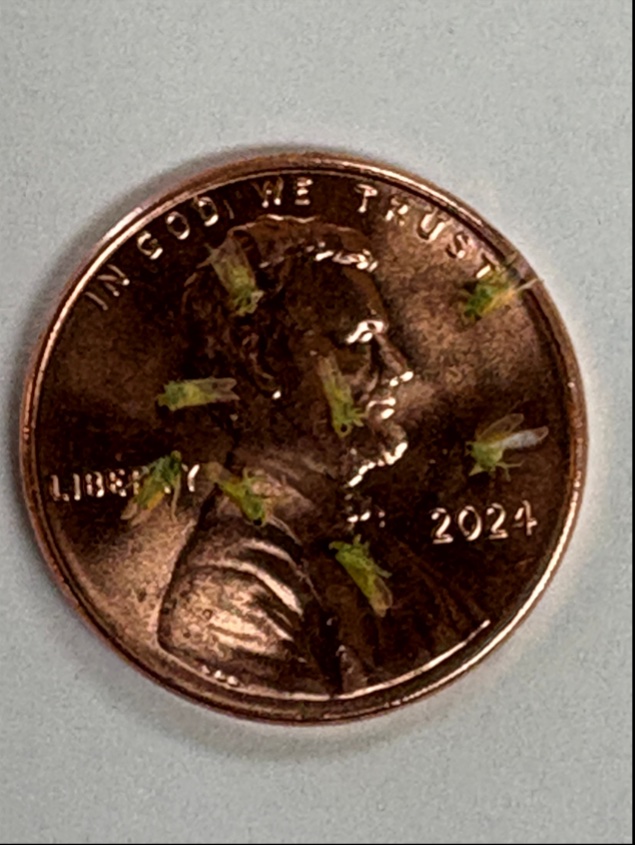
Cotton jassids on the heads side of a penny. / Photo courtesy of UGA
Once jassids are detected, if farmers delay spraying 5-7 days it will be too late to prevent the insects from damaging cotton plants. Maintaining potash levels appears to be important to minimize plant injury symptoms, though research has yet to show why, Roberts said.
UGA research also showed the bugs’ affinity for field edges. Plants on the sides of fields, which Roberts calls “indicator plants,” tend to show jassid damage first. It’s important for growers to keep an eye on those plants.
Last year, UGA researchers noticed jassids showing up on yellow sticky cards placed in fields to assess white fly populations, so they began using the cards to gauge the jassid populations as well. The highest concentration of jassids appeared on the fourth leaf stem below the top terminal bud, Roberts said, giving an indication of where to look.
“Going into 2026, our threshold is going to be an average of one jassid per leaf when sampling at least 25 leaves per field,” Roberts said.
If more than that are found, it’s time to make the first pesticide application.
Vary pesticides to prevent immunity
What makes jassids particularly troublesome is they quickly build pesticide immunity, a trait often present in rapidly reproducing insect species. Roberts said they are already immune to every pesticide available in their native India, where cotton varieties have been bred to resist jassids.
UGA’s pesticide trials showed the following products provided good control of jassids: Argyle, Bidrin, Carbine, Courier, Vertento, Sefina, Sivanto and Venom. Products that provided moderate control were Admire Pro, Assail, bifen+imid, Centric, Orthene and Transform.
Roberts said it will likely take 10 years or more before jassid-resistant cotton varieties are available in the U.S. In the interim, it’s important farmers vary the pesticides they use to prevent jassids developing immunity to products.
What’s next?
Roberts said the UGA Cotton Team is researching a number of questions including:
• Where are the jassids now?
• How do cold temperatures affect winter survival?
• When will they infest the 2026 cotton crop? If earlier than in 2025, will the population thresholds for applying pesticides change?
• How long to protect cotton?
• What is the toxin the jassids introduce during feeding?
• Are any cotton varieties jassid-resistant?