GFB News Magazine
Georgia counties receive drought disaster designation
by GFB staff
Posted on May 27, 2026 7:57 AM
The month of May brought much-needed rain to most of Georgia, easing – temporarily, at least – the lack of water many Georgia farmers struggled with in the first quarter of the year.
According to the Georgia Forestry Commission, Jan. – March was the 8th driest first quarter on record dating back to 1895.
Drought conditions have persisted for most of the state dating back to early fall 2025. Some farmers reported their last meaningful rain being in August, compounding extreme economic conditions (see pages 6-8) and affecting planting decisions and practices. Some chose to irrigate.
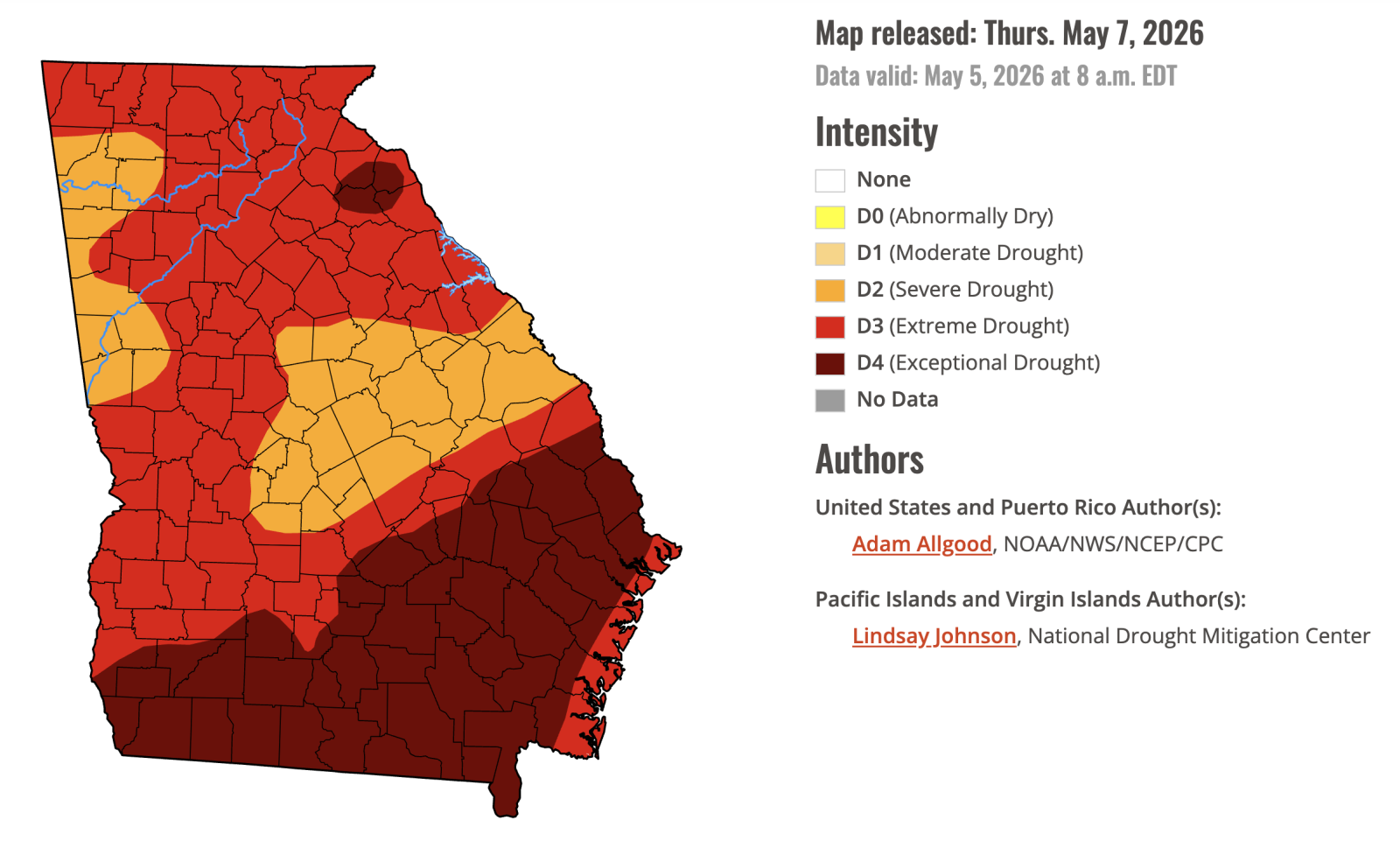
The National Drought Mitigation Center categorizes drought intensity in five levels: D0 – abnormally dry; D1 – moderate drought; D2 – severe drought; D3 – extreme drought; and D4 – exceptional drought.
By May 7, the USDA had issued natural disaster declarations for drought covering virtually every county in the state. According to the U.S. Drought Monitor, these counties suffered from a drought intensity value during the growing season of 1) D2 for 8 or more consecutive weeks or 2) D3 or D4.
Georgia counties receive drought disaster designation
On April 21, the USDA issued a natural disaster designation for 126 Georgia counties due to drought conditions. USDA announced April 29 that another 20 counties received primary drought disaster designation. Producers in the primary counties, as well as producers in contiguous counties, are eligible for emergency loans, which can be used to meet various recovery needs including the replacement of essential items such as equipment or livestock, reorganization of a farming operation, or to refinance certain debts. The Farm Service Agency will review the loans based on the extent of losses, security available and repayment ability.
According to the U.S. Drought Monitor, these counties suffered from a drought intensity value during the growing season of 1) D2 Drought-Severe for 8 or more consecutive weeks or 2) D3 Drought-Extreme or D4 Drought-Exceptional.
These counties received the primary drought designation April 21 and have a Dec. 10 application deadline: Appling, Atkinson, Bacon, Baker, Banks, Barrow, Ben Hill, Berrien, Bibb, Bleckley, Brantley, Brooks, Bryan, Bulloch, Burke, Calhoun, Camden, Candler, Catoosa, Charlton, Chatham, Chattahoochee, Clarke, Clay, Clinch, Coffee, Colquitt, Columbia, Cook, Crawford, Crisp, Decatur, Dodge, Dooly, Dougherty, Early, Echols, Effingham, Elbert, Emanuel, Evans, Fannin, Forsyth, Franklin, Gilmer, Glascock, Glynn, Grady, Greene, Gwinnett, Hall, Hancock, Harris, Hart, Houston, Irwin, Jackson, Jeff Davis, Jefferson, Jenkins, Johnson, Lamar, Lanier, Laurens, Lee, Liberty, Lincoln, Long, Lowndes, Lumpkin, McDuffie, McIntosh, Macon, Madison, Marion, Meriwether, Miller, Mitchell, Monroe, Montgomery, Morgan, Murray, Muscogee, Oconee, Oglethorpe, Peach, Pierce, Pulaski, Quitman, Randolph, Schley, Screven, Seminole, Stephens, Stewart, Sumter, Talbot, Taliaferro, Tattnall, Taylor, Telfair, Terrell, Thomas, Tift, Toombs, Towns, Treutlen, Troup, Turner, Twiggs, Union, Upson, Walker, Walton, Ware, Warren, Washington, Wayne, Webster, Wheeler, White, Whitfield, Wilcox, Wilkes, Wilkinson, and Worth. Contiguous Counties Also Eligible: Baldwin, Cherokee, Floyd, Heard, Jones and Richmond.
These counties received a primary disaster declaration on April 27 and have a Dec. 23 application deadline: Butts, Chattooga, Clayton, Coweta, Dade, Dawson, DeKalb, Fayette, Fulton, Gordon, Habersham, Henry, Jasper, Newton, Pickens, Pike, Putnam, Rabun, Rockdale and Spalding. Contiguous counties also eligible are Banks, Bartow, Carroll,Cobb, Douglas and Fannin.
Polk Co. is eligible to apply as a contiguous county to Cherokee Co., AL; Dec. 21 is application deadline.
Visit farmers.gov, the Disaster Assistance Discovery Tool, Disaster Assistance-at-a-Glance fact sheet, and Loan Assistance Tool for more information. Contact your local USDA Service Center to file a Notice of Loss or ask questions about programs.
The May 5 U.S. Drought Monitor report, released May 7, showed every county in Georgia with at least some portion under severe drought. Of Georgia’s 159 counties, 149 were in extreme drought and/or exceptional drought. The most intense drought conditions – exceptional drought – were present in 51 counties in the Coastal Plain of South and Southeast Georgia and an additional six counties in Northeast Georgia.