GFB News Magazine
Georgia farmers facing tough times and tough decisions
by Jay Stone
News Writer
Posted on June 1, 2026 11:23 PM
It is often said that farmers are the ultimate optimists. They plant seeds and do what they can to facilitate their growth, believing their crop will yield a bountiful harvest.
Lately, that belief is being subjected to rigorous testing. The economic conditions in which Georgia farmers find themselves are making it hard for many of them to see the way through this crop and on to the next one, even with their deep faith.
“It’s one of those things where you can’t be a farmer and not be a Christian because if you don’t have faith, you’ll never make it,” said Thomas County farmer Julie Hardy. “At the same time, I’m still human, so while I like to say, ‘Let go and let God,’ it’s hard. My anxiety has definitely been higher than normal.”
Decisions, decisions
Across the U.S., farmers are choosing to downsize where possible, see if they can get by using less or different fertilizer, or rework their acreage choices between crops. In some cases, they’re getting out altogether.
“We may trim some seed per acre,” Ware County farmer David Morgan said. “There’s really nothing we can do other than potentially let it lay out (not plant).”
Morgan, who farms in partnership with his wife, Lindsey, said because of costs, he didn’t plant land this year that has produced lower yields in the past.
“There’s a lot of people around us who scaled back and there are some people who decided not to farm any more at all,” Morgan said. “It could easily happen if [the federal government] doesn’t keep sending subsidy checks. Everything’s out of our control. Our pricing … I mean, we can’t just go to the gin or the peanut mill and tell them what we want for a price. They’d laugh us out of there.”
Cotton, corn and peanut producers aren’t the only ones being pushed into difficult decisions. In Toombs County, Vidalia onion producer Aries Haygood said the margins are thin for one of the state’s most famous commodities. He estimated costs for seed, fertilizer, fuel, crop protection, labor, irrigation, insurance and permanent staff runs to about $15,400 per acre. If he can get $24 per box of onions – he said an average acre produces about 650 boxes – he can generate $15,600 from that acre.
“That’s if everything goes perfect,” Haygood said.
2026 has not been perfect, with ongoing drought meaning more irrigation and more expense.
He’s trimmed his onion acreage to use some of the acres for cabbage, watermelons and peas, and opened a farm store to create non-onion production streams of revenue.
And the possibility of getting out?
“That crosses my mind about every day now, but I’ve made a commitment to my family, my father-in-law, the banks, everyone else,” Haygood said. “So, I’m going to go down fighting. I have to try to bring in different cash flows.”
Counting the losses
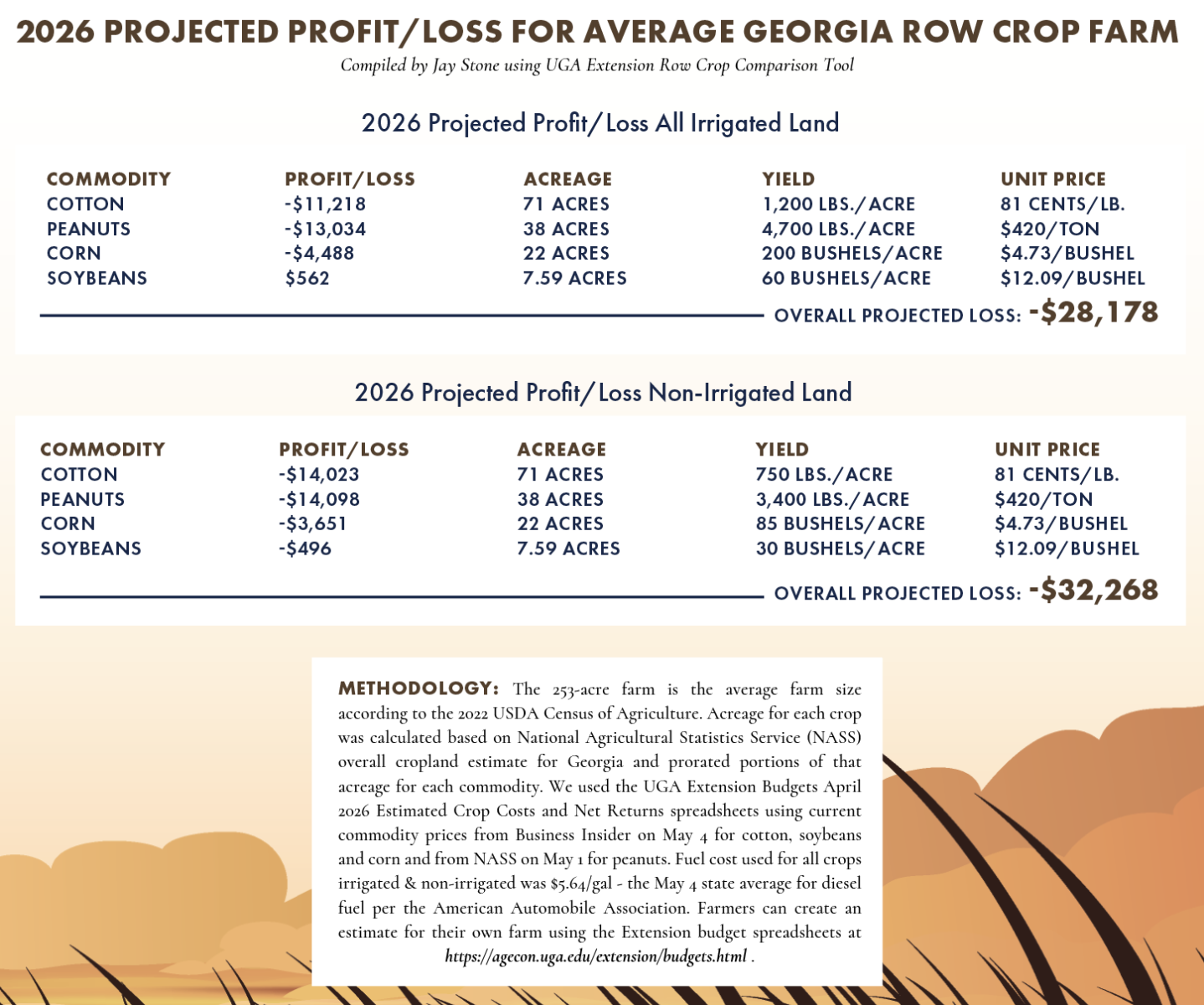
In Georgia, the average farm size is approximately 253 acres according to the 2022 USDA Census of Agriculture, and on that farm the producer would plant 71 acres in cotton, 38 acres in peanuts, 22 acres in corn and 7 ½ acres in soybeans. (See Methodology at end of article.)
Using UGA Extension’s 2026 Crop Budget Tool and entering current numbers for diesel fuel and commodity prices offers projections of profits or losses for each commodity. If the farmer irrigates all of that acreage, his or her projected losses are $28,178. With no irrigation, the projected losses would total $32,268.
The budget tool, compiled by UGA Extension Agricultural economists, shows projected expenses for seed, fertilizer, crop protection, irrigation, labor, and equipment maintenance outpacing expected revenues for most of Georgia’s major crops.
In January, UGA used an average diesel fuel price of $3 per gallon. Fast-forward through April, and diesel prices spiked to $5 or more per gallon. On May 4, according to the American Automobile Association (AAA), Georgia’s average price for diesel fuel was $5.64.
Fuel price increases make anything that has to be transported more expensive. Most notably for farmers has been fertilizer. Fertilizer price increases came at the time when most Georgia farmers were gearing up for planting and ordering fertilizer. See information on AFBF’s fertilizer survey on pages 8 and 9.
In 2025, Georgia farmers lost almost $800 million, according to Farm Bureau analysis of USDA data. In seven of the last 11 years, overall farm production expenses have exceeded revenue. This presents a different perspective on sustainability than the prevailing themes in public discourse, which mainly centers on ecological sustainability and conservation.
Heavy hearts
In a vocation that is often generational, the mental and emotional toll of these struggles can be overwhelming.
“I feel like I have a concrete block sitting on my chest. There’s nights I don’t sleep,” Hardy said.
During the GFB Presidents’ Trip to D.C., in March, Sumter County Farm Bureau President Matt Berry made the point in multiple meetings with lawmakers that he could be the generation that loses his family’s farm.
Berry has been steadfast in advocating for farmers’ mental health. Normally an outgoing, cheerful person, he’s still prone to wonder, in light of all the economic challenges, what he’ll be able to pass on to his sons if they choose to pursue agriculture.
“I have days that I think, ‘This life’s got to be better than this,’” Berry said. “Why, Lord? Why? I mean we all have those days right now.”
To farm or not to farm
The numbers of farm bankruptcies show the economic challenges are becoming more existential for some farms. In Georgia, there were 27 Chapter 12 (farm) bankruptcies in 2025, up from 11 in 2024. This may not sound like many, with nearly 40,000 farms in the state, but a 145% increase is eye-opening, and every one of them carries negative ripple effects.
“When farms shut down, communities also lose access to fresh, local food,” said GFB President Tom McCall. “We need thriving rural communities, and farmers are essential to continuing sustainability of rural life.”