GFB News Magazine
Young Farmers & Ranchers encouraged to pursue acts of service
by Jay Stone
News Writer
Posted on October 9, 2026 2:41 PM
The theme for the 2026 Georgia Farm Bureau Young Farmers & Ranchers (YF&R) Summer Leadership Conference was “Rise & Thrive.” The event offered multiple opportunities for attendees to do just that through workshops providing tips on how to be better farmers and activities connecting existing and new friends. The conference took place July 15-18 on Jekyll Island. Approximately 250 YF&R families enjoyed the annual conference.
There was also an unofficial subtheme: Let’s look out for each other. Conference attendees assembled more than 13,000 meals for distribution through a local food bank, and they heard messages of service from keynote speaker Lt. Col. Dan Rooney and NAMEIT founder Lindsey McCann. More on NAMEIT can be found here.
Attendees learned about various programs offered through the USDA to help young and beginning farmers succeed, new tools to help navigate complex pesticide use issues, things to consider before deciding to run for public office, and important issues to address when starting an agritourism business.
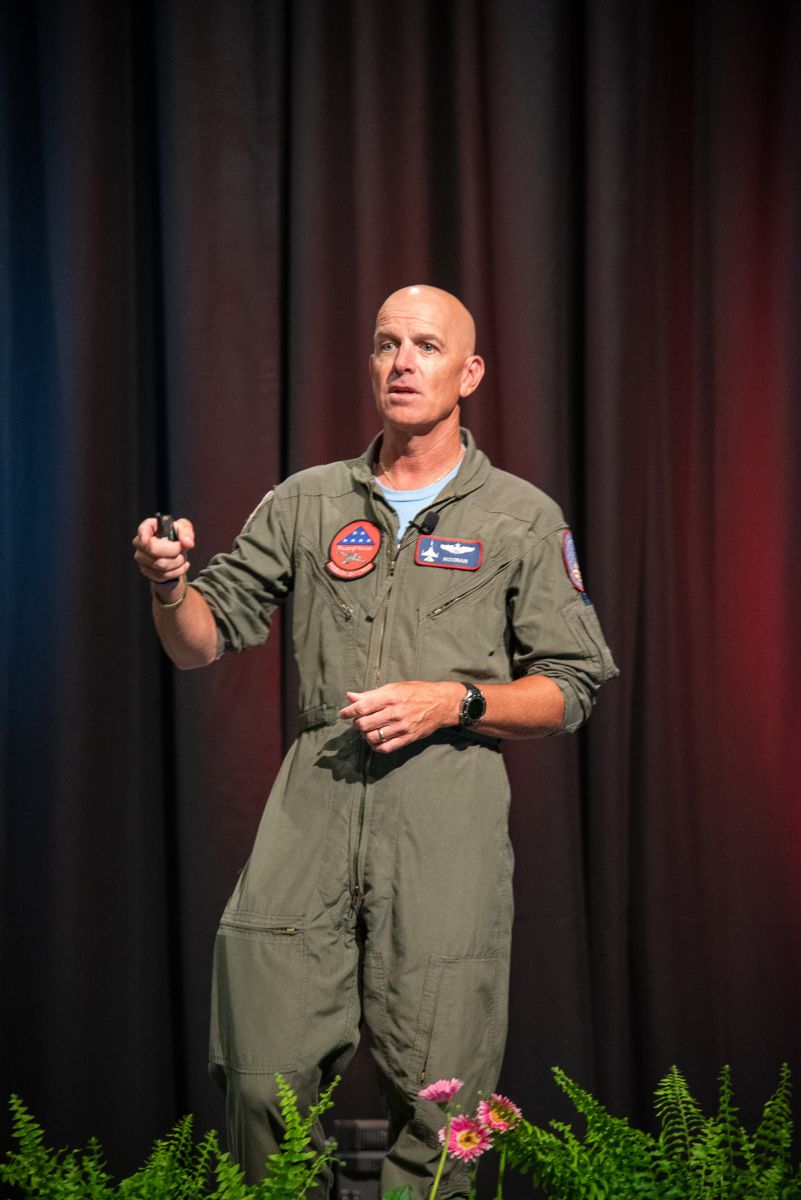
While giving the keynote address, Lt. Col. Dan Rooney, Air Force pilot and founder of the Folds of Honor scholarship fund, offered tips for living a fulfilling life. /Photo by Logan Thomas
Rooney offers views on living a life of purpose
Rooney, an Air Force fighter pilot veteran, former professional golfer and founder of the Folds of Honor scholarship program, delivered an inspirational keynote address, emphasizing discipline, faith and service to others.
Folds of Honor provides scholarships to family members of fallen service members or to service members who sustain debilitating injuries. In the past year, Rooney said, Folds of Honor provided scholarships to approximately 700 people in Georgia.
“These are military families, first responder families who’ve had somebody killed or critically wounded coming to rescue us defending freedom,” Rooney said. “My ask for everybody here is visit our website, www.foldsofhonor.org , and share our website with your family and friends.”
Rooney authored “Fly Into the Wind: How to Harness Faith and Fearlessness on Your Ascent to Greatness.” He currently serves as commander of recruiting in the Oklahoma Air National Guard.
Singleton offers tips to navigate pesticide regulations
During one of six educational breakout sessions, UGA Extension Sustainability Specialist Taylor Singleton presented information about the Endangered Species Act (ESA) and tools to help farmers stay compliant. The EPA, in its function of approving pesticide registrations, has to ensure ESA compliance for 1,200 registered active ingredients. Under the ESA, there are 1,685 protected species.
“We have to make sure to read the labels of the products that we’re using. We’re required to check; we’re required to implement these ESA mitigations,” Singleton said. “Then we need to show in our records that we’ve done this.”
A key portion of this is minimizing drift and runoff in Pesticide Use Limitation Areas (PULAs). To aid farmers with compliance, the EPA offers Bulletins Live! Two – an online map-based tool that shows PULA requirements for specific areas. It can be accessed at https://gfb.ag/BLT2.
The EPA also offers the Pesticide App for Label Mitigations (PALM), which features a runoff/erosion calculator and a spray drift calculator to help farmers avoid pesticide exposure to “nontarget” species. The PALM app can be accessed at https://gfb.ag/PALM.
Thinking about running for office?
During breakout sessions, American Farm Bureau Federation Director of Advocacy and Political Management Mike Sistak shared important principles to consider when evaluating whether to run for a public office. Sistak runs the non-partisan AFBF Campaign School, which is typically offered by state Farm Bureaus.
Principles for candidates:
1. Parties cannot get you elected.
Sistak said political parties are concerned with top-of-ballot races like president, governor, House or Senate.
“It is up to you because nobody else is going to care as much as you do because frankly, it’s your reputation on the line. Your name is on the ballot,” Sistak said.
2. Elections are more often lost than won.
One controversial statement can cost a person considered a shoo-in the election. Sistak noted a Virginia governor’s race in which former Gov. Terry McAuliffe said in a televised debate, “I don’t think parents should be telling schools what they should teach.” McAuliffe went from a healthy lead in the polls to a narrow loss.
The lesson, Sistak said, is to be very careful what you say.
3. 1 + 7 = 8.
One campaign donor will tell seven other people about a candidate and encourage them to support the same candidate.
4. 14/86.
Fourteen percent of people consider themselves the political class – the people in our society actively involved in governance, policy making and with political power. Candidates, Sistak said, should focus their campaign efforts on the remaining 86%.
5. Campaigns are perceptions. All politics are personal.
“We’re not voting for somebody because we know every single issue that’s going to be happening at the city council or at the state capitol,” Sistak said. “We’re making a judgment of that candidate that they’re going to go to the state capitol and to the best of their ability, they are going to represent the interests of our communities.”
6. Candidates have three responsibilities
Raising money, getting their message out and asking for votes are the three things candidates have to do. Sistak said some candidates spend as much as 65% of their time raising money.
Government resources for building first-generation farms
USDA Public Affairs Specialist Amelia Dortch, who serves as the Natural Resource Conservation Service’s (NRCS) beginning farmer and rancher coordinator, gave conference attendees a summary of federal resources available to young and beginning farmers to help them get started. Dortch outlined how to determine which agency is appropriate when seeking federal help.
Dortch said farmers should reach out to FSA for loans and farm records, NRCS for technical and financial assistance to address soil, water, air, and other natural resource concerns, and Rural Development for value-added grants and cooperative agreements that support farm business development.
“If you need something to help you with irrigation, you will start with NRCS. If you need a micro loan to help you build a structure on your farm, you will start with FSA. If you need a value-added producer grant, you will start with Rural Development,” Dortch said.
Building income through agritourism
Karissa Ruth of Sara’s Fresh Market in Ridge Spring, S.C., offered pointers on creating farm income opportunities by adding agritourism activities. Ruth noted that for the farmer, an agritourism venue gives opportunities to diversify income, build trust and transparency with customers, gain immediate feedback from customers and give farmers more control over pricing and marketing.
The farm’s trademark greeting is “Hey Peaches!” Ruth said her overarching focus is on creating and maintaining a family atmosphere.
“I want people to feel like family, and they just happen to take home some produce,” she said. “That’s the way we make sure we treat everybody.”
Ruth walked attendees through key aspects of an agritourism business plan, including location relative to population, financial feasibility, permitting, parking, insurance and more.
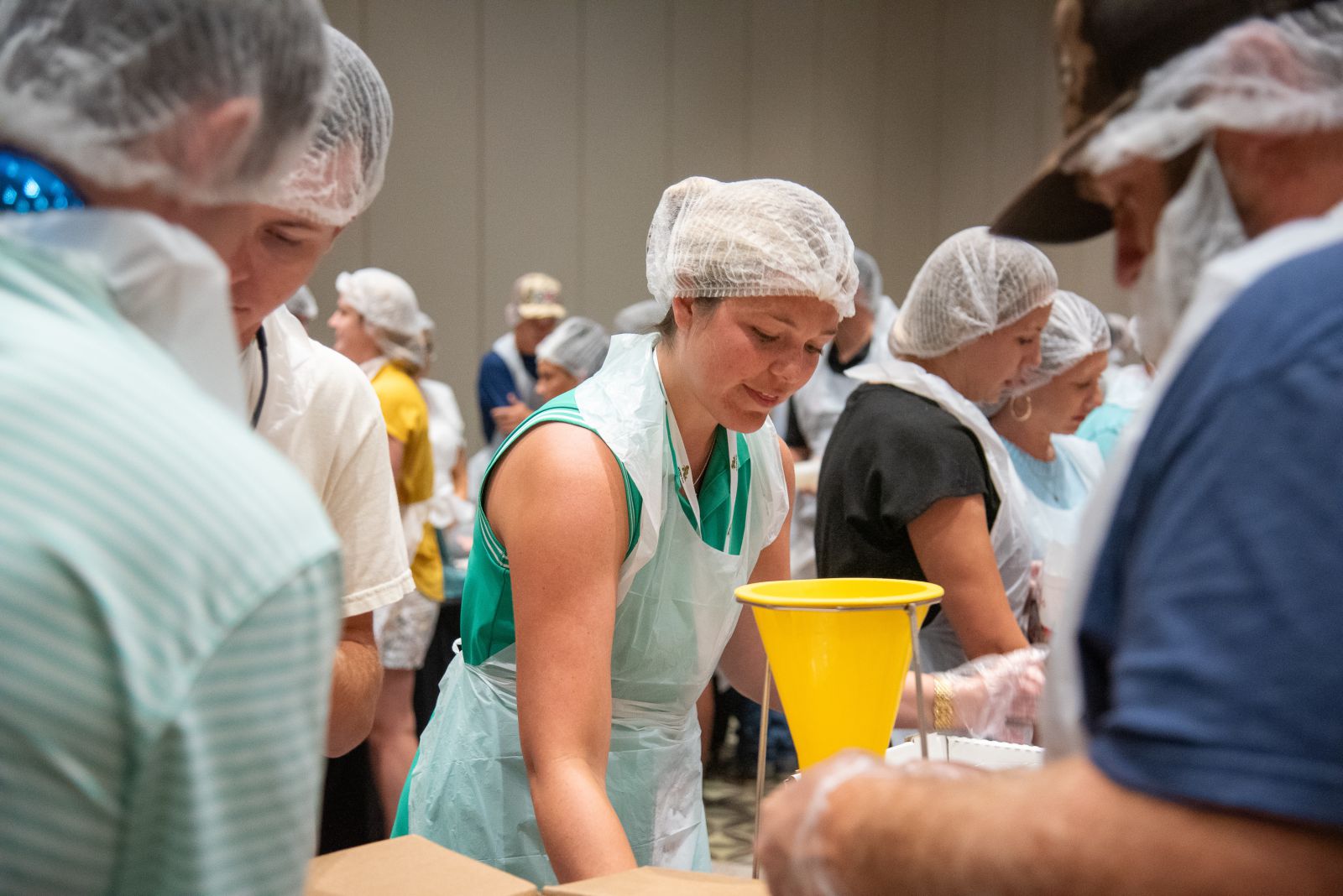
Young Farmers & Ranchers packed about 13,000 meals for distribution through a local food bank. /Photo by Logan Thomas