Federal Update - February 26

Federal Update
February 26, 2026
In this Issue:
- Row Crop - Farmer Bridge Assistance
- Speciality Crop - Assistance for Speciality Crop Farmers
- Emergency Livestock Relief Program
- Modernized Farm Bill Text Under Consideration
-
Trump Ensures an Adequate Supply of Elemental Phosphorus and Glyphosate-based Herbicides
Row Crop - Farmer Bridge Assistance (FBA)
On February 20, 2026, Secretary Rollins announced that the U.S. Department of Agriculture (USDA) is opening the enrollment period for the Farmer Bridge Assistance (FBA) Program. The program provides $11 billion in one-time bridge payments to eligible row crop producers.
Pre-filled applications will be available online for producers who have a Login.govaccount and who timely filed their 2025 crop acreage report for eligible commodities. Producers may access and submit their pre-filled applications through the Farm Service Agency (FSA) website at fsa.usda.gov/fba. In addition, producers may request their pre-filled FBA application from their local FSA county office.
The deadline to submit completed FBA applications is April 17, 2026. Applications may be submitted online or delivered to the local FSA county office. Commodity-specific payment rates and additional eligibility information are available through the program guidance materials found here.
Specialty Crop - Assistance for Specialty Crop Farmers (ASCF)
On February 13, 2026, USDA announced that the reporting deadline for the Assistance for Specialty Crop Farmers (ASCF) Program is March 13, 2026. The ASCF Program allocates $1 billion in assistance for specialty crop producers under the broader Farmer Bridge Assistance program.
Commodity-specific payment rates are expected to be released by the end of March. Crop insurance linkage will not be required for specialty crop producers participating in this program. Additional information, including a list of eligible commodities, is available in the official USDA press release here.
Emergency Livestock Relief Program (ELRP)
On February 13, 2026, Secretary Rollins announced that USDA's Farm Service Agency has issued final payments under the Emergency Livestock Relief Program (ELRP), totaling more than $1.89 billion.
USDA is issuing a second payment to producers who previously received an initial factored payment under ELRP for 2023 and 2024 losses resulting from eligible drought events. Initial assistance payments were factored at 35 percent to ensure total disbursements remained within available funding.
FSA has now issued an automatic second payment to eligible producers. This payment equals 8.2 percent of the producer's 2023 or 2024 Livestock Forage Disaster Program gross calculated payment, resulting in a final cumulative payment factor of 43.2 percent.
Modernized Farm Bill Text Under Consideration
The U.S. House Committee on Agriculture is scheduled to hold a markup of the Farm, Food, and National Security Act of 2026 on March 3rd at 5:00 PM, marking a critical step toward advancing this important legislation. This bill strengthens the farm safety net and provides meaningful improvements to risk management tools that farmers rely on to operate in an increasingly volatile economic and weather environment. Among its key provisions, the legislation enhances marketing loan programs to provide producers with greater flexibility and access to capital, helping ensure farmers can continue operating during challenging market cycles, disaster recovery periods, and even potential appropriations lapses.
Crop insurance remains a cornerstone of the farm safety net, and the bill reinforces its effectiveness while establishing a standing block grant program for disaster assistance. This permanent disaster assistance framework provides rapid, predictable support following natural disasters such as hurricanes, droughts, floods, or freezes, eliminating the uncertainty and delays associated with ad hoc disaster programs. By creating a standing mechanism, the bill ensures farmers have timely access to resources needed to recover and continue production. These improvements strengthen the partnership between producers and crop insurance while providing a more reliable and responsive safety net that reflects the growing frequency and severity of weather-related disasters.
The legislation also includes meaningful improvements for specialty crop producers by establishing tools to help address market volatility and rising production risks. Specialty crop producers often face unique challenges due to price fluctuations, labor costs, and perishability, and the bill provides targeted assistance to help stabilize their operations and maintain competitiveness. These provisions help ensure fruit, vegetable, and specialty crop producers have access to risk management tools that more closely mirror the protections available to traditional row crop producers, supporting diversification and strengthening the overall agricultural economy.
We urge you to encourage your Members of Congress serving on the House Agriculture Committee and urge them to support and advance this bill. These improvements to commodity programs, crop insurance, disaster assistance, and specialty crop protections are essential to ensuring farmers can manage risk, recover from disasters, and continue providing a safe, abundant, and affordable food supply for our nation. To see the full farm bill text click here.
More agriculture policy news here.
Trump Ensures an Adequate Supply of Elemental Phosphorus and Glyphosate-based Herbicides
The recent Executive Order to ensure an adequate domestic supply of elemental phosphorus and glyphosate-based herbicides represents a major victory for American agriculture, and a critical step toward protecting the future of U.S. food production. By recognizing these inputs as essential to national security under the Defense Production Act, the administration has acknowledged what farmers have long known, these tools are vital to maintaining crop yields and ensuring a stable food supply. Glyphosate-based herbicides play an essential role in allowing farmers to effectively control weeds, protect crop health, and maximize productivity. While phosphorus is a foundational component in agricultural inputs necessary for crop growth. This decisive action brings much-needed certainty at a time when supply chain disruptions, rising input costs, and global instability have threatened farmers' ability to access the tools they depend on.
This action is a significant win for food security in the United States because it prioritizes domestic production and reduces reliance on foreign sources for critical agricultural inputs. Ensuring a stable and reliable supply of these materials gives farmers confidence that they will be able to continue producing food efficiently and sustainably, even in the face of global uncertainty. At a time when agriculture is already facing tremendous economic pressure, this move helps strengthen the resilience of the U.S. food system, protect rural livelihoods, and safeguard the nation's ability to feed itself. By taking this proactive step, policymakers have reinforced the importance of American agriculture and delivered meaningful support that will help farmers continue to provide the safe, abundant, and affordable food supply that families across the country depend on.
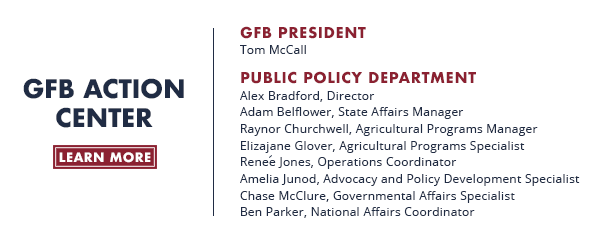
Thank you for taking an active role in staying up-to-date and informed on the developments at our State Capitol. If you have additional questions, feel free to reach out to any of our Public Policy Department Staff and we will be happy to assist you.
Alex Bradford, Director
Adam Belflower, State Affairs Manager
Raynor Churchwell, Agricultural Programs Manager
ElizaJane Glover, Agricultural Programs Specialist
Renee Jones, Operations Coordinator
Amelia Junod, Advocacy and Policy Development Specialist
Chase McClure, Governmental Affairs Specialist
Ben Parker, National Affairs Coordinator